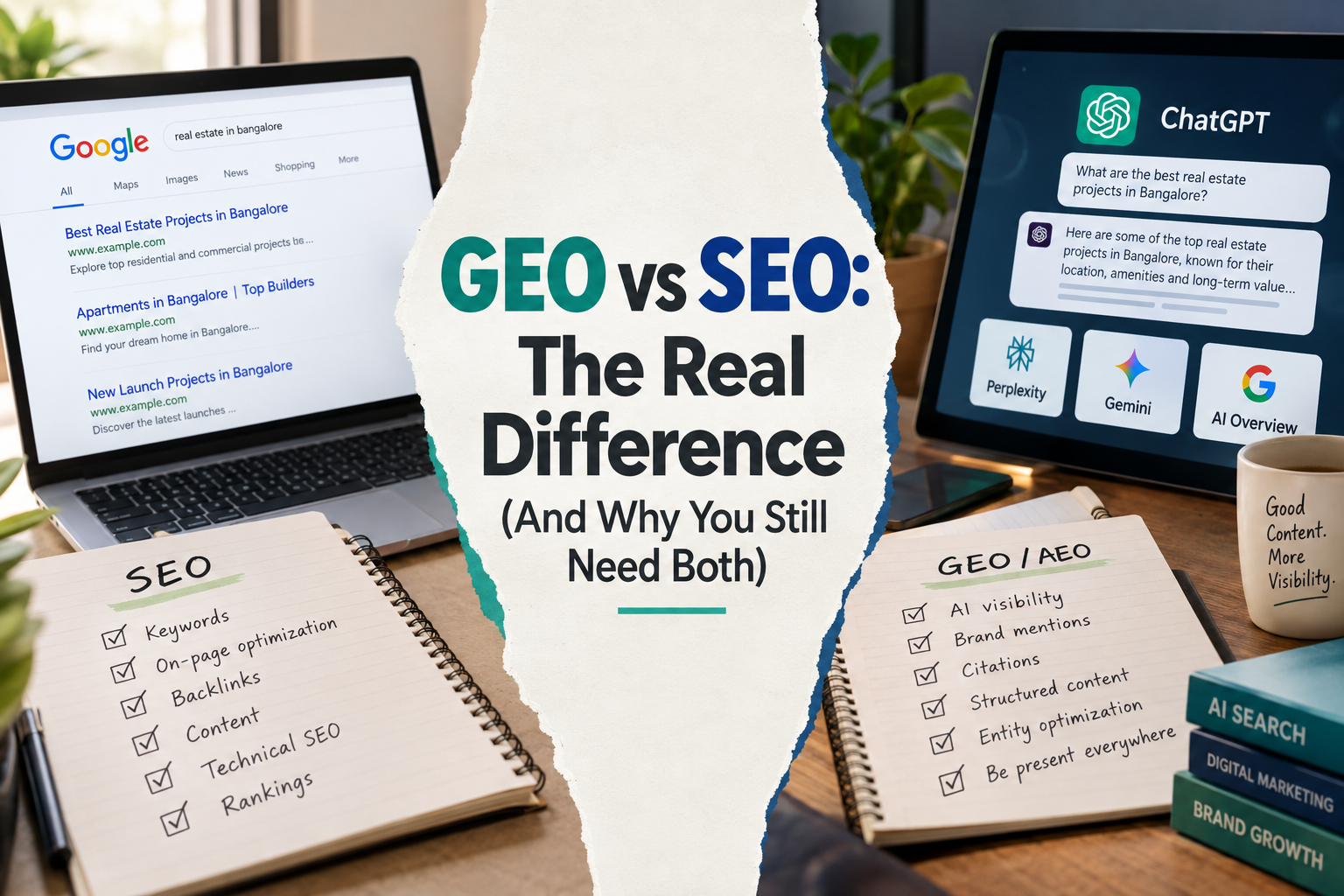


Over 97% of Indian property buyers start their search online. Most of them start on Google — not on 99acres, not on MagicBricks. Yet most builder and agent websites in India generate almost no organic traffic, rely entirely on paid portals, and have no search asset to show for years of marketing spend.
This guide is a practical, step-by-step playbook for fixing that. It covers real estate SEO specifically for the Indian market — with separate tracks for builders and developers versus channel partners and brokers — and includes the tactics that most generic SEO guides miss entirely: RERA-compliant page structure, NRI buyer content, AI search visibility, and how to rank above portals for the queries that matter most.
If you are a builder spending on portals with no organic growth, or a channel partner with a website that gets no traffic, this is where to start.
What is real estate SEO in India?
Real estate SEO in India is the practice of optimising a property developer’s or agent’s website to rank in Google’s organic results for location-specific, project-specific, and buyer-intent property searches. It reduces dependence on paid portals and generates qualified leads at a fraction of the long-term cost of paid advertising.
Key Takeaways
- Over 97% of Indian property buyers begin their search online, making organic search the highest-value lead channel for real estate businesses in 2026.
- Real estate SEO generates the highest ROI of any industry — 1,389% average return, according to First Page Sage’s 2026 research.
- Builders and channel partners need different strategies: builders should prioritise project-specific landing pages and content clusters; agents should focus on hyperlocal Google Business Profile optimisation and neighbourhood content.
- Property portals (99acres, MagicBricks) cannot rank for brand-name or project-specific queries — that is exactly where an independently optimised website wins.
- RERA-compliant project pages with RealEstateListing schema markup consistently outperform generic listing pages in Google rankings.
- AI search systems like Google’s AI Overviews and ChatGPT are now part of the Indian buyer’s research journey — real estate websites need to be structured for LLM retrieval, not just traditional search.
- A Mumbai-based developer working with Touchstone Infotech achieved 3x more organic leads within six months of implementing a structured real estate SEO strategy.
Why Most Real Estate Websites in India Don’t Generate Leads
Most builder and agent websites in India have the same problem: they exist, but they don’t work.
The site looks reasonable. There’s a project gallery, a contact form, maybe a WhatsApp button. But the organic traffic report in Google Search Console shows 200–300 visits a month, mostly brand searches. Zero leads from Google. The marketing budget goes into 99acres, MagicBricks, and Meta ads — and the cost keeps climbing.
This is the portal dependency trap, and most real estate businesses in India are stuck in it.
Portals provide rented visibility. The moment you stop paying, you disappear. You are also competing directly against every other developer on the platform, bidding for the same buyer’s attention. Your brand doesn’t build. Your website doesn’t rank. And every lead you get is technically owned by the portal, not by you.
The data tells a clear story. Cost-per-lead on Meta and Google Ads in Indian real estate has risen 30–50% over the past two years. Meanwhile, organic search traffic converts eight times better than paid traffic for real estate, because buyers trust search results in a way they don’t trust ads. And 97% of Indian property buyers start their search online — on Google, not on a portal homepage.
The shift happened gradually. Buyers used to browse portals first. Now they search Google first and use portals as a comparison tool. That is a fundamental change in buyer behaviour, and most real estate marketing budgets have not caught up with it.
Real estate SEO is the alternative. In 2026, it is the clearest path to building a lead channel you actually own.
What Is Real Estate SEO — and Why India Is Different
Real estate SEO is the process of optimising a property developer’s or agent’s website so it appears in Google’s organic results when buyers search for properties, builders, or real estate services. Unlike paid ads, organic rankings do not stop when the budget does. The work compounds over time.
In practice, it means: the right keywords on the right pages, a technically sound website that Google can crawl efficiently, a credible backlink profile, and content that matches what buyers are actually searching for at each stage of their decision.
India adds specific layers that most generic SEO guides ignore
First, search patterns here are hyperlocal and configuration-specific. An Indian buyer doesn’t search “apartments for sale.” They search “2 BHK flat in Sector 62 Noida under 70 lakhs.” The keyword intent is granular in a way that requires project-level content — not generic service pages.
Second, RERA compliance affects how project content must be structured. Pricing, carpet area, possession dates, and RERA registration numbers are all mandatory on project-facing pages. A page built correctly for RERA compliance is also a stronger SEO page — because it is specific, factual, and contains the exact details buyers search for.
Third, the competitive landscape is unusual. Portals like 99acres, MagicBricks, and Housing.com dominate broad property searches. But they cannot rank for a builder’s brand name, a specific project name, or a hyper-local neighbourhood query like “plots near Sarjapur Road Bangalore.” Those are exactly the searches an independently optimised website can win.
Builders and channel partners have different SEO goals — and different strategies
For a builder or developer, the goal is project-specific: rank for queries tied to your projects, your locations, and your brand. The playbook centres on project landing pages, content clusters, and backlinks from property media.
For a channel partner or broker, the goal is authority in a service area. You want to rank for “property dealer in [neighbourhood]” and “flats for sale in [area].” The playbook centres on Google Business Profile, hyperlocal content, and review management.
Both approaches share the same foundation. The execution differs.
Step 1 — Keyword Research for Real Estate Websites
Keyword research in real estate starts with the buyer journey, not the keyword tool.
Indian property buyers typically spend three to six months researching before they speak to a developer or agent. That research phase has a predictable shape.
Top of funnel (awareness): Broad, question-based searches. “Is now a good time to buy property in Hyderabad?” “What is the difference between carpet area and built-up area?” “Home loan eligibility for salaried employees.”
Middle of funnel (consideration): Location and configuration-specific searches. “2 BHK flats in Whitefield Bangalore.” “New projects in Gurgaon sector 58.” “Best builders in Pune 2026.”
Bottom of funnel (decision): Brand and project-specific searches. “Lodha Palava review.” “Godrej Park Retreat possession date.” “RERA registration Mahindra Lifespaces.”
Most builder websites only have content for the bottom of the funnel — project pages. Channel partner websites often have nothing at all. The opportunity is in the middle: location-specific, configuration-specific content that captures buyers while they are still comparing options and haven’t committed to a developer.
Keyword examples by persona
For builders: Primary keywords should combine project name, configuration, and locality — “3 BHK flats in [project name] [area].” Secondary keywords should cover the locality and configuration without the brand, capturing buyers who don’t know you yet: “luxury apartments in Wakad Pune,” “under-construction projects in Electronic City Bangalore.”
For channel partners: Focus on service-area keywords. “Property dealer in [neighbourhood].” “Flats for sale in [area].” “2 BHK rent [locality].” These have lower competition than developer-targeted terms and convert well because the buyer is often close to a decision.
Tools to use
Start with Google Search Console — it shows what you are already ranking for, which is often more useful than starting from scratch. Cross-reference with SEMrush or Ahrefs for volume and competition data. Google’s “People Also Ask” and autocomplete are underused for real estate keyword research and reveal exactly the questions buyers type at each funnel stage.
One practical note: don’t chase broad terms like “real estate India” or “property investment.” These are dominated by portals and national media. Go specific — specific to your city, your micro-market, your project type, your buyer segment.
Step 2 — Build a Project-First Website Architecture
A single-page portfolio site — five project thumbnails, a contact form, and a footer — cannot rank for anything. Google needs multiple, distinct pages with specific content to understand what you offer, where you operate, and who you serve.
The most effective architecture for a builder website follows a content cluster model built around each project.
The project content cluster
One main project page covering the full project details — RERA number, configuration options, carpet area, pricing band, amenities, location, connectivity, possession timeline, and floor plans. This page is built for both the buyer and for Google. It needs to contain the exact terms buyers search: “2 BHK,” “ready to move,” “RERA approved,” alongside the locality name.
Three supporting blog posts targeting related informational queries. If your project is in Hinjewadi, Pune, these might be: “Is Hinjewadi a good place to buy a home in 2026?”, “Top 5 residential projects near Hinjewadi Phase 2,” and “Home loan guide for first-time buyers in Pune.” These posts link back to the project page and attract buyers at the research stage.
One locality guide covering schools, hospitals, connectivity, price trends, and upcoming infrastructure in the area. These pages rank for neighbourhood searches and build topical authority around your service areas.
One FAQ page answering common buyer questions about your project, the buying process, and RERA compliance. FAQ pages rank well for voice queries and AI-generated answers.
Together, these five pages form a cluster that supports each other through internal links and gives Google a complete picture of your authority in that locality.
RERA-compliant page structure for SEO
Your project pages need RERA registration numbers prominently placed, accurate possession dates, carpet area breakdowns, and pricing that matches RERA filings. Buyers search for RERA details — “RERA approved flats in [area]” is a real query with real volume. Pages that include this information rank better and convert better.
Internal linking
Every blog post in the cluster should link to the main project page using anchor text that includes the project location and type. The project page should link to the locality guide. The locality guide should link back to your main real estate services page. This structure distributes authority across the cluster and helps Google crawl efficiently.
Step 3 — Local SEO and Google Business Profile
For channel partners, local SEO delivers the fastest returns on this entire list. For builders, it is underused and often misconfigured.
Google Business Profile for builders
Most builders set up a single GBP listing for their registered office and leave it there. A better approach is to create separate GBP listings for each project site office — particularly for projects under active sales. Buyers who search “new flats near [area]” or “builder in [locality]” will see project-specific listings in map results, not just a corporate address. Each project listing should include project photos, accurate category (“Real Estate Developer”), the RERA number in the description, and a direct link to the project landing page on your website.
Google Business Profile for channel partners
Your GBP is your most direct path to map pack visibility. A well-optimised profile with accurate NAP (name, address, phone), neighbourhood-level categories, updated photos, and a consistent stream of reviews can put a one-person brokerage in the top three map results for “[locality] property dealer” — above agencies with far larger ad budgets.
Citations and directory consistency
Property portals are not just lead sources — they are citation sources. Consistent NAP details across 99acres, MagicBricks, Housing.com, JustDial, Sulekha, and IndiaMART strengthen your local SEO signals. Inconsistent details — different phone numbers, old addresses — actively hurt your rankings.
Review strategy
Ask for reviews at the right moment: after a site visit, after booking confirmation, after possession. Don’t batch-ask all clients at once — Google’s systems detect unusual review spikes. A steady flow of specific, detailed reviews (“helped us find a 3 BHK near Whitefield metro within our budget”) outperforms generic five-star ratings for both trust signals and keyword relevance.
Step 4 — Content That Attracts Buyers, Not Just Traffic
Most real estate content strategies make the same error: they write for buyers who have already decided to buy. The higher-value opportunity is capturing buyers who are still deciding where, what, and whether to buy.
Locality guides and neighbourhood pages
A well-researched guide to Hinjewadi, Whitefield, Sector 150 Noida, or Sarjapur Road — covering schools, hospitals, metro connectivity, price trends, new infrastructure projects, and rental yield data — ranks for dozens of buyer-intent queries. These pages rarely go stale, attract backlinks from local media, and position you as the area expert rather than just another listing source.
NRI investment content — a traffic opportunity most developers ignore
According to ANAROCK Research, NRI real estate investment in India has grown significantly in recent years, and NRI buyers disproportionately rely on online research. They can’t visit sites in person from Dubai or Sydney, so they research far more thoroughly before committing. Dedicated guides on “NRI property investment process India,” “how to buy property in India from the UAE,” or “rental yield in Mumbai vs Hyderabad for NRI investors” attract a buyer segment with high purchase intent and — in many markets — above-average ticket size. Almost none of the builder websites currently ranking in India have this content.
NRI buyers in the USA and Australia tend to search in English and use broader terms before narrowing by city. “Best cities to invest in property in India” and “RERA compliant builders in Bangalore” are typical entry queries. Content targeting this audience should explain regulatory context clearly — RERA basics, FEMA remittance rules, city-level investment comparisons — in plain English, without assuming familiarity with Indian market dynamics.
Market reports, price trend blogs, and home loan FAQs
“Property prices in Gurgaon 2026.” “Is this a good time to buy in Bangalore?” These articles attract buyers in the comparison and consideration stages and establish your website as an authoritative source rather than a pure listing platform.
Home loan FAQs and stamp duty guides are underestimated lead drivers. A buyer figuring out “how much stamp duty in Maharashtra 2026” is within weeks of a purchase decision. If your website answers that question, you are the first brand they associate with useful information.
Video SEO and virtual tour optimisation
Listings with video content receive 403% more enquiries than those without. Beyond the engagement benefit, video content optimised with VideoObject schema markup can appear directly in Google search results as rich results. Upload virtual tours to YouTube with location-specific titles and descriptions, embed them on project pages, and add VideoObject schema with accurate duration, upload date, and thumbnail URL.
Step 5 — Technical SEO for Real Estate Websites
Technical SEO is where real estate websites in India lose the most ground — and where some of the fastest ranking improvements are available.
Core Web Vitals
Real estate sites are image-heavy by nature — project photos, floor plans, location maps, and virtual tour embeds. Without optimisation, these sites load slowly and fail Google’s Core Web Vitals assessment, which directly affects rankings. The fixes are practical: compress images to WebP format, lazy-load content below the fold, defer non-critical JavaScript, and replace portal embed iframes with direct links where possible. A site that loads in under three seconds on mobile will outrank an equivalent site that takes five seconds, all else being equal.
Mobile-first
More than 70% of real estate searches in India happen on mobile devices. Google indexes the mobile version of your site first. If your project pages have text that is too small to read on a phone, form fields that are difficult to tap, or maps that don’t load on cellular data, you have a mobile usability problem that will suppress rankings regardless of content quality.
RealEstateListing schema markup
Schema tells Google exactly what type of page this is, what property is listed, its price range, configuration, and location. When implemented correctly, it can generate rich results in the SERP — showing price, configuration, and availability directly below your listing in search results. This increases click-through rates meaningfully. The implementation requires JSON-LD code added to project pages — a one-time developer task with lasting returns.
XML sitemaps and crawl budget
For builder websites with many project pages, sold-out project pages often waste crawl budget — Google sends its crawlers to pages that haven’t been updated in years. Audit your sitemap quarterly. Remove or consolidate sold-out project pages, redirect them to your main projects page or a relevant locality landing page, and make sure your sitemap accurately reflects your live, rankable content.
HTTPS
If your website is still running on HTTP, fix it immediately. It is a direct ranking signal and a trust signal for buyers entering personal details into contact forms.
Step 6 — Backlinks and Digital PR for Builders
Backlinks from credible, relevant sources signal to Google that your website has authority worth ranking. For real estate, the most practical sources are closer than most builders realise.
Property portals as citation sources
99acres, MagicBricks, and Housing.com all allow project listings with a link to your website. These are not high-authority editorial links, but they are consistent, indexed citations from real estate-relevant domains. Ensure every portal listing has an accurate, active link to the correct project page — not your homepage.
Press releases for project launches
When you launch a project, receive a RERA approval, win an award, or achieve possession, there is a genuine news story. A well-written press release distributed to property media — Realty+ Magazine, Track2Realty, Housing News — and picked up by local news sites generates both referral traffic and credible backlinks. This is digital PR for builders: the approach brand-name developers use to build the kind of link profile that sustains long-term rankings.
Guest posts on real estate media
Articles in MagicBricks News, 99acres Blog, or local city property publications earn links from domains your buyers already trust. Topics like “What homebuyers in [city] should know before buying in 2026” are straightforward to pitch and position your brand as a credible authority.
What to avoid
Bulk directory submissions, paid link schemes, and “1,000 backlinks for ₹5,000” packages cause more damage than they prevent. Real estate already faces scrutiny from Google’s spam detection systems because the category has historically attracted manipulative SEO. Any link building that looks unnatural will earn a penalty, not a ranking.
Step 7 — AI Search Visibility for Real Estate (The 2026 Layer)
A growing share of Indian property buyers now use AI search tools as part of their research. Google’s AI Overviews appear at the top of many real estate queries and summarise information from multiple websites before the buyer clicks anything. ChatGPT and Perplexity are used by NRI buyers and urban professionals to ask questions like “which are the most RERA-compliant builders in Pune?” or “best areas for property investment in Bangalore in 2026.”
If your website content doesn’t answer these questions clearly and directly, AI systems will cite your competitors instead.
How to structure content for LLM retrieval
Write answers, not descriptions. A page that begins “Hinjewadi is a fast-growing IT corridor in Pune…” is a description. A page that begins “Hinjewadi offers 2 and 3 BHK apartments ranging from ₹60 lakhs to ₹1.2 crore, with possession-ready projects from RERA-approved builders, located 22 km from Pune airport…” is an answer. AI systems prefer the second format because it is immediately usable as a citation.
Include a dedicated FAQ section on every major project page and locality guide. Direct Q&A format is what LLMs extract most reliably. Questions like “Is [project name] RERA approved?”, “What is the price per sq ft in [locality]?”, and “What are the schools near [project]?” should all be answered directly on the page.
What makes a real estate website citation-worthy in AI search
Specificity. Named entities. Sourced data. Pages that cite RERA registration numbers, include possession timelines, reference local infrastructure projects by name, and provide actual price ranges are far more likely to be referenced by AI systems than pages that say “luxury homes in a prime location with world-class amenities.”
This is also where Touchstone Infotech’s SEO services apply directly to real estate — structuring content, entity coverage, and factual density so your pages rank in traditional search and get cited in AI-generated answers. If you want to understand what this looks like for your specific project portfolio, the audit is the starting point.
Measuring Real Estate SEO Performance
More traffic is not the goal. More qualified enquiries from organic search is the goal.
The metrics that matter
Organic traffic — baseline measurement, tracked monthly in GA4. Don’t stop here. Traffic without context is a vanity metric.
Keyword rankings — which queries are you ranking for, at what position, and what is the movement month-on-month? Track this in Google Search Console or SEMrush. Priority rankings to monitor: your project names, your locality + configuration keywords, and your “property dealer/developer in [area]” terms.
Google Maps rankings — for channel partners especially, map pack visibility for hyperlocal searches drives direct calls and walk-ins. BrightLocal tracks this at the postcode level.
Organic lead volume — the number of enquiries where the source is organic search, tracked via GA4 goal completions tied to contact form submissions, call tracking, and WhatsApp click events. This is the number that justifies the investment.
Cost per organic lead — total SEO spend divided by organic leads generated. For real estate, this typically becomes significantly more favourable than paid CPL after the six-to-nine month mark.
A real example
A Mumbai-based developer working with Touchstone Infotech’s real estate digital marketing team implemented a structured real estate SEO strategy — project landing pages built to the content cluster model, Google Business Profile optimisation for project site offices, and a locality content programme across three micro-markets. Within six months, organic lead volume had tripled relative to their pre-SEO baseline, with no increase in paid ad spend.
Real Estate SEO Cost and Timeline in India
What to realistically expect
Months 1–3: Technical fixes, page restructuring, Google Business Profile setup, keyword-mapped content. Rankings typically begin moving in month three to four for lower-competition locality keywords.
Months 4–6: Initial lead generation from organic. Long-tail and local queries start converting. This is when the first measurable ROI appears.
Months 6–12: Compounding returns. Content clusters begin supporting each other. Domain authority builds. Previously competitive terms become reachable.
Real estate SEO is not a three-month sprint. The developers and brokers who benefit most are the ones who treat it as a 12-to-24 month investment.
India pricing benchmarks
Individual agents and small brokers typically spend ₹10,000–₹50,000 per month on SEO services. Builders and developers with multiple active projects typically invest ₹75,000–₹2,00,000 or more per month, depending on the number of projects and geographic spread.
SEO vs. portal fees — the long-term comparison
A developer spending ₹1,00,000 per month on portal listings spends ₹12,00,000 per year to rent visibility. That same investment in SEO, sustained over 12 months, builds a traffic asset that continues generating leads in year two without additional spend. Real estate carries the highest SEO ROI of any industry — a 1,389% average return according to First Page Sage’s 2026 research, or roughly ₹13.89 in value for every ₹1 invested. The long-term economics are straightforward.
Frequently Asked Questions
How long does real estate SEO take to generate leads in India?
Most real estate websites see initial ranking movement within three to four months. Meaningful organic lead generation typically begins between months five and seven. The compounding benefit — where organic leads become a consistent, reliable channel — usually comes in the nine-to-twelve month range.
Is SEO better than 99acres or MagicBricks for property leads?
They serve different purposes. Portals provide short-term, immediate visibility in exchange for ongoing fees. SEO builds organic rankings you own, which compound over time. The most effective real estate marketing setups in India use both — portals for immediate lead flow and SEO as the long-term asset. The difference is that SEO leads you own; portal leads you rent.
What keywords should a builder target for SEO?
Start with project-specific keywords: your project name, configuration (2 BHK, 3 BHK), locality, and relevant qualifiers (RERA approved, ready to move, under construction). Then target locality + configuration queries without your brand — these capture buyers in the research stage who don’t know you yet. Avoid broad terms like “property investment India” — these are dominated by portals and national media.
What schema markup should a real estate website use?
At minimum: Article schema for blog content, LocalBusiness schema for your business entity, and RealEstateListing schema for project pages. The RealEstateListing schema is particularly important — it allows Google to display pricing, configuration, and availability as rich results in the SERP, which increases click-through rates significantly.
How do channel partners do local SEO differently from builders?
Channel partners should focus primarily on Google Business Profile optimisation, hyperlocal keyword targeting by neighbourhood, review management, and NAP consistency across property directories. The goal is map pack visibility for “property dealer near me” and “[locality] flats for sale” queries — not project-level content, which is the builder’s domain.
Does real estate SEO work for NRI buyers?
Yes, and it is an underused opportunity. NRI buyers research online far more than domestic buyers, because they cannot visit project sites in person. Content covering the NRI property buying process, RERA compliance, FEMA remittance rules, and city-level investment comparisons ranks well and converts buyers with high purchase intent.
How much does real estate SEO cost in India?
Individual agents typically invest ₹10,000–₹50,000 per month. Builders and developers with multiple active projects typically invest ₹75,000–₹2,00,000 or more per month, depending on scope. Real estate has the highest SEO ROI of any industry — approximately ₹13.89 in value for every ₹1 invested, according to First Page Sage’s 2026 data.
How do I rank above 99acres or MagicBricks on Google?
Focus on your brand name, project-specific queries, and hyper-local micro-neighbourhood searches — the three areas where portals consistently fail to outrank an independently optimised website. Build detailed, RERA-compliant project landing pages, create locality-specific content with original data, and ensure your Google Business Profile is fully optimised. No portal can outrank you for your own brand or project in sustained organic search.
Your Real Estate Website Should Be Generating Leads — Let’s See Why It Isn’t
Every builder and agent website has a different reason for not ranking. Some have technical issues Google cannot crawl past. Some have the wrong keywords. Some have content that covers the right topics but in the wrong structure. Some have no content at all.
A real estate SEO audit identifies exactly where the gap is — and what it will take to close it.
Touchstone Infotech has worked with developers and channel partners across India, including a Mumbai-based developer who tripled organic lead volume in six months. If you want to know what is holding your website back, the audit is where to start.