
Say your clinic’s Instagram posted three things last week: a patient’s thank-you reel, a Diwali discount on laser sessions and a “best dermatologist in Delhi” graphic. Under guidelines the National Medical Commission (India) brought into force on 6 October 2026, each of those is now a prohibited or restricted practice.
The same document leaves plenty of room to post. This guide to the NMC’s social media guidelines for doctors shows where the line sits, rewrites seven common posts so they land on the right side of it, and ends with a one-week cleanup plan for accounts that already carry years of content.
Quick answer
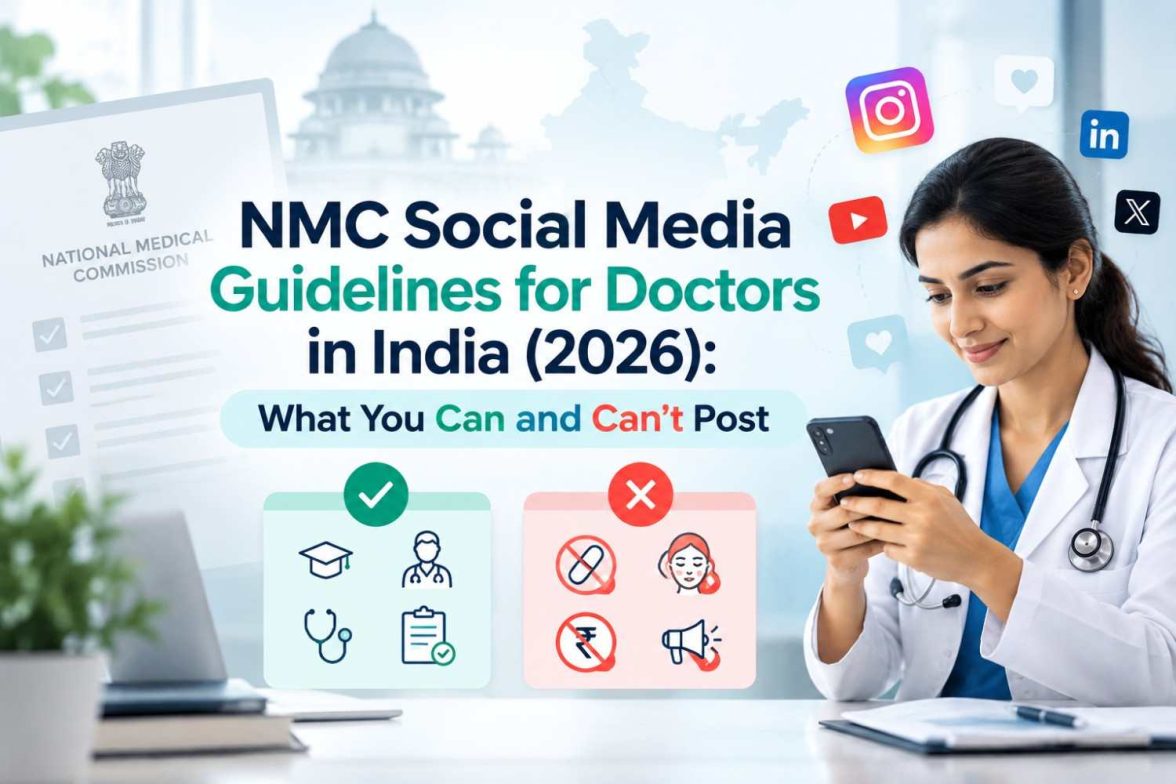
The NMC social media guidelines for doctors sit inside the Guidelines on Ethical Advertising and Public Communication, issued by the National Medical Commission’s Ethics and Medical Registration Board on 6 October 2026 (public notice No. R-13014/01/2024-Ethics). Doctors may post health education, and their posts should disclose name, qualifications, registration status and State or National Medical Register number. Self-promotion, patient testimonials, before-and-after photos, “best doctor” claims, discount offers and bought followers are prohibited. A State Medical Council can respond with anything from a warning to removal from the register for one to three years.
Key takeaways
- ✓The guidelines have applied since 6 October 2026 and are read with the 2002 Professional Conduct Regulations and the NMC Act, 2019.
- ✓The test is promotion. Health information shared without promotional intent is not an advertisement.
- ✓Posts should carry your name, qualifications, registration status and SMR/NMR number.
- ✓Patient consent does not make a testimonial or a before-and-after photo permissible.
- ✓You answer for what your agency posts, and pay-per-patient arrangements are barred.
What are the NMC social media guidelines for doctors in 2026?
There is no separate booklet called “social media guidelines”. The rules are part of a document titled Guidelines on Ethical Advertising and Public Communication by Hospitals/Medical Institutions and Registered Medical Practitioners. They apply to every registered medical practitioner (RMP) on the National or a State Medical Register, and to hospitals and clinics as clinical establishments.
For doctors, they are read with the Indian Medical Council (Professional Conduct, Etiquette and Ethics) Regulations, 2002 and the NMC Act, 2019 (para 4.2). Many older articles still quote the 2023 conduct regulations and their “11 rules” for social media. The 2026 guidelines do not refer to those.
The reach is wide. Para 3.5 names websites and blogs, WhatsApp, Telegram, Facebook, podcasts, influencer marketing, sponsored posts and online healthcare platforms as media of advertisement, alongside print, television and radio.
The one test: is this post teaching or selling?
Para 3.2 defines an advertisement as any communication that directly or indirectly solicits or promotes a doctor’s or hospital’s services, reputation, skills, qualifications, achievements or facilities. Sponsored, targeted, influencer-led, search-engine and AI-generated content all count when they have a promotional character.
The same paragraph carves out an exemption. Information given to the public in the normal course, without promotional intent or commercial benefit, is not an advertisement (Explanation I).
A reel showing how to use an inhaler correctly is information. The same reel ending with “limited slots this week, book your asthma consultation” is an advertisement.
A rough test, and this is our reading, not the NMC’s wording: would the post still be useful to someone who never becomes your patient? If yes, it sits on the information side.
What doctors can and can’t post on social media
The table maps common content types to the clause that governs them.
| Content | Status | Clause |
|---|---|---|
| Health education and awareness content that does not promote your practice | Allowed | 5.1, 3.2 Explanation I |
| Public health talks in your own name and designation | Allowed | 8.2(iii) |
| Research you have published in a reputed medical journal | Allowed | 8.2(i) |
| Formal announcements: starting practice, new address, change in type of practice, temporary absence, consultation fees | Allowed, kept factual | 8.2(ii), 9.3 |
| Greetings on days of national importance | Allowed, without promotion | 8.2(v) |
| “Best doctor”, “No.1 specialist”, “100% success”, “painless treatment”, “guaranteed cure” | Prohibited | 8.1(iii), 8.1(ix) |
| Patient testimonials, reviews and recommendations shared for promotion | Prohibited | 3.2 Explanation V, 8.1(xi) |
| Before-and-after photos, surgical results, celebrity patients, success stories | Prohibited, except strictly scientific or educational use with anonymised consent | 8.1(v) |
| Discounts, limited-period offers, coupons, cashback or free procedures used as inducements | Prohibited | 8.1(x) |
| Endorsing a drug, device, supplement or other product | Prohibited | 8.1(iv) |
| Fear-based messaging that creates demand for procedures or tests | Prohibited | 8.1(i) |
| Bought followers, likes, views, reviews or ratings | Prohibited | 8.1(xii) |
| Identifiable patient data such as names, faces or anomalies | Prohibited | 7.4 |
Words such as “leading” or “most trusted” are barred unless the claim is objectively verifiable and rests on a transparent, independently checkable methodology (para 8.1(ix)).
Seven common posts, rewritten
Clinic feeds tend to repeat the same handful of post types. Here is each one next to a version that stays on the education side.
Instead of
“Best dermatologist in Delhi. Book your slot today.”
Post this
“Adult acne: four common triggers, and when it is worth seeing a dermatologist.”
Why: superiority claims and solicitation are barred (paras 8.1(ii), 8.1(iii), 8.1(ix)).
Instead of
A reposted patient reel: “Doctor changed my life.”
Post this
A short video on what recovery after the same procedure usually involves, week by week, risks included. No patient appears in it.
Why: doctors may not share patient testimonials for promotion on social media (para 3.2, Explanation V).
Instead of
A before-and-after grid captioned “Results speak for themselves.”
Post this
A diagram-led explainer: how the procedure works, who it suits, who it does not, and what can go wrong.
Why: before-and-after photographs and surgical results cannot be used for promotion (para 8.1(v)).
Instead of
“Diwali offer: 30% off laser sessions. Ends Sunday.”
Post this
A plain statement of fees: “Consultation: Rs [amount]. Procedure charges are listed on our website.”
Why: discounts and limited-period offers used as inducements are barred, while a factual disclosure of charges is allowed (paras 8.1(x), 9.3).
Instead of
“100% painless, scarless surgery. Guaranteed.”
Post this
“What to expect from laparoscopic surgery: anaesthesia, incisions, recovery time and risks.”
Why: guarantees and “painless” claims are named as examples of prohibited assertions, and risks must not be concealed (paras 8.1(iii), 8.1(vi)).
Instead of
“Chest pain? You could be days from a heart attack. Get our full cardiac package now.”
Post this
“Chest pain: which symptoms need emergency care, and which can wait for a routine appointment.”
Why: fear-based marketing and promoting unnecessary diagnostics are barred (para 8.1(i)).
Instead of
A reel recommending a named supplement brand.
Post this
“How to read a supplement label, and which claims need evidence.” No brand is named.
Why: a doctor may not endorse any drug, device or health product, paid or unpaid (para 8.1(iv)).
These rewrites are our reading of where the line sits. Each one still needs the disclosure line below, and none should end with a booking push.
The disclosure line every post needs
Explanation III to para 3.2 says a doctor publishing electronic media posts should transparently disclose four things: name, qualifications, registration status and State Medical Register (SMR) or National Medical Register (NMR) number. Explanation IV asks clinics and hospitals to do the same for each doctor their posts name.
No format is prescribed. This one fits a caption on most platforms. Copy it and fill in the brackets:
Whether a line in the profile bio is enough is not stated. The wording refers to posts, so the cautious reading is to put it in each caption. Use the qualifications recorded on the register.
What to post instead: eight formats that stay educational
Para 5.1 lets doctors take part in health awareness programmes and produce educational content. Three conditions come attached: the content does not promote your personal practice, does not solicit patients, and is not monetised through promotional marketing. These formats fit inside that.
- “What to expect” explainers for a procedure or test, with the risks included.
- Myth versus evidence, with the source named in the caption.
- “When to see a doctor” guides for a common symptom.
- Preparation checklists for an appointment, a scan or a fasting blood test.
- Seasonal public health reminders, such as dengue prevention or heat safety.
- Plain-language summaries of new guidance from bodies such as ICMR or WHO.
- Your published research, summarised for a general reader (para 8.2(i)).
- Formal announcements: a new address, changed hours, leave dates or consultation fees (paras 8.2(ii), 9.3).
Testimonials, reviews, awards and ads: eight situations, answered
Clause numbers are hard to apply in the abstract. Here is how they play out in eight situations a clinic account is likely to meet.
A patient tags you in a thank-you story. Can you repost it?
No. Explanation V says an RMP shall not request or share patient testimonials, recommendations, endorsements or reviews for professional promotion on social media. Reposting it to your own feed is sharing it. Thank the patient privately.
The patient signed a consent form for before-and-after photos. Does that make them usable?
Not for promotion. Para 6.2 says consent, by itself, does not make a testimonial or a before-and-after depiction permissible. Para 8.1(v) allows cases only for strictly scientific or educational purposes with anonymised consent, and para 6.4 requires identifying marks to be cropped, blurred or blacked out.
A patient leaves a Google review without being asked. Is that a problem?
Not addressed. The guidelines bar requesting reviews for promotion, sharing them on social media, and anything fake, paid or manipulated. Unprompted reviews are not mentioned. Leave the review where it is and do not screenshot it for Instagram. If your front desk runs a “please rate us five stars” routine for a named doctor, pause it and take advice.
Someone comments asking about your fees or how to book.
Not addressed directly. Comment replies are not mentioned, but a factual disclosure of charges is allowed (paras 8.1(x), 9.3). Our reading: answer factually or point to the clinic’s contact page, with no urgency and no offer.
Your hospital wants you as the face of its next campaign.
Decline. Hospital advertising may not contain a promotional portrayal of an individual RMP (para 8.3(ii)), and a doctor who personally authorises or takes part in a prohibited communication can be examined separately (para 11.5). A website directory with your name, qualifications, specialty, registration details and availability is fine (para 9.1).
You have won an award. Can it go in your bio?
With care. Any ranking or award relied on in advertising must be independently verifiable, with the awarding body, date and methodology disclosed where needed (para 8.1(ix)). An award with no published selection method is best left out.
A listing platform offers a paid slot that ranks you higher.
No. Para 9.4 requires healthcare platforms to follow the same norms and prohibits paid ranking of doctors. Para 8.1(xii) separately bars manipulating search rankings or visibility to create a misleading impression of professional standing.
A news channel invites you to talk about dengue.
Yes. Para 8.2(iii) allows talks on public health through television, radio and electronic media in your own name and designation, without promoting your employer. Keep it educational: interviews “intended for promotion” count as advertising (para 3.5).
Can doctors use AI to create content?
The guidelines do not ban AI as a writing aid, but para 7.2 sets limits. AI-generated promotional campaigns run for commercial interest are prohibited, and any AI-generated promotional content that otherwise complies must carry a source mark stating that its origin is AI. Those two sentences sit awkwardly together. The NMC has kept the power to issue clarifications (para 12), so watch for one.
The sub-clauses are clearer. AI must not be used to create or alter a patient’s image, voice, testimonial or clinical outcome, or to fake an endorsement. It must not produce misleading claims about diagnosis, treatment or outcomes. Patient information fed into an AI tool must comply with privacy and data protection law.
In practice, an AI-assisted draft of a patient education article, checked line by line by the doctor whose name is on it, is a different thing from an AI-generated “patient” praising your clinic. The first needs review. The second is barred outright.
Websites, Google Business Profile and paid ads
Websites and blogs are listed as a medium of advertisement (para 3.5), so a clinic website is held to the same standard as an Instagram feed.
Clinics and hospitals have more room than individual doctors. Paras 8.3 and 9.1 let an establishment publish factual, objective and verifiable information: name, location, contact details, departments, facilities, equipment, emergency services, accreditation and charges. An accurate Google Business Profile fits inside that. What it cannot carry is superiority claims, guarantees, inducements or a promotional portrayal of one doctor. Keeping those details current is routine Google Business Profile management.
Paid ads are harder. Sponsored and targeted posts count as advertising whenever they are promotional, and a doctor’s photograph is not permitted where its use amounts to self-advertisement (para 9.2). A clinic-level ad that states facts has some footing in para 8.3. A campaign built around one doctor’s face and a “book now” button is hard to square with para 8.1(ii).
On search, para 8.1(xii) bars manipulating rankings or algorithms to create a misleading impression of professional standing. Our reading is that publishing accurate educational content which patients find through search is a different activity. That is an interpretation, and the councils will draw the line.
If an agency runs your account
Outsourcing the posting does not outsource the responsibility. Para 4.4 says publishing through an agency, platform or influencer does not absolve a doctor or institution of content it authorised, commissioned, sponsored, adopted or knowingly permitted.
Para 8.1(ii) also says a doctor shall not engage a third party for marketing medical services. Read strictly, that leaves little room to hire anyone to promote a personal practice. Our reading is that help producing educational content in the doctor’s own name is a different activity, but the guidelines do not say so in terms. Take advice before signing a retainer.
Whatever the arrangement, these five lines belong in the brief. They apply to any agency, Touchstone Infotech included, whether the work is healthcare marketing for a hospital or social media marketing for a clinic.
Copy into your agency brief
- No testimonials, patient stories, before-and-after images or review requests.
- No superlatives, guarantees, success rates, offers or countdowns.
- Every post carries the doctor’s disclosure line and is approved by the doctor in writing before it goes out.
- Fees are fixed or time-based, never per lead, per appointment or per patient (paras 8.1(vii), 8.1(viii)).
- AI-generated visuals, audio and video are labelled as AI. No synthetic patients.
The 60-second check before you post
Run every post, reel, story and broadcast through five questions.
- ✓Would this still be useful to someone who never visits my clinic?
- ✓Does the caption carry my name, qualifications, registration status and number?
- ✓Is it free of superlatives, guarantees, success rates, offers and deadlines?
- ✓Is it free of patients in every form: face, name, story, review, before-and-after?
- ✓If anything in it is AI-generated or sponsored, is that stated?
Five yeses and it can go out. One no and it goes back for a rewrite.
A 7-day cleanup for accounts that are already live
The guidelines say nothing about posts published before 6 October 2026. But old posts stay visible, and a complaint can cite whatever is on your profile today. The cautious approach is to treat everything still live as current communication. If you are unsure whether to archive or delete something, especially after a complaint, ask a medico-legal adviser first.
- Day 1. List every channel that carries your name: Instagram, Facebook, YouTube, LinkedIn, WhatsApp broadcast lists, website, Google Business Profile and listing platforms.
- Day 2. Archive testimonial posts, reposted patient stories, before-and-after grids and celebrity-patient posts.
- Day 3. Rewrite bios, highlights, pinned posts and website headers. Remove “best”, “No.1”, “leading”, “top”, “painless”, “guaranteed” and any success-rate claim you cannot verify.
- Day 4. Stop running offers. Pause ads and broadcasts built on discounts, coupons, free procedures or countdown urgency.
- Day 5. Add the disclosure line to your caption templates and to the posts you intend to keep.
- Day 6. Check your AI use. Label AI-generated promotional visuals and video, and remove anything showing a synthetic patient or endorsement.
- Day 7. Read agency and platform contracts for pay-per-lead or pay-per-patient terms, and set up a sign-off step with a dated record of who approved each post.
Penalties and appeals
Para 10.1 lists graded action that the State Medical Council “may” contemplate. None of it is automatic.
| Situation | Action the council may take |
|---|---|
| First violation | Warning and mandatory ethics training |
| Second violation | Censure and monetary penalty |
| Third violation | Suspension of registration for 3 to 6 months |
| Serious violation, such as misleading cure claims, inducements to patients or digital mass solicitation | Suspension for 6 to 12 months |
| Repeated violations | Removal from the medical register for 1 to 3 years |
A council has to issue a show-cause notice and hear the doctor before any penalty (para 10.2), then pass a reasoned order (para 10.3). An appeal lies to the NMC’s Ethics and Medical Registration Board within 60 days, with a second appeal available after that (para 11). Hospitals and clinics are dealt with under the Clinical Establishments Act or the relevant State Act.
What this means for your practice
Take away the clause numbers and the guidelines ask one question of everything you publish: is this teaching, or is this selling? Teaching is protected. Selling yourself is what the document was written to stop.
The second shift is accountability. Your name and registration number now travel with each post, and “the agency posted it” is no defence. Whoever runs the account, see every post before it goes out and keep a record that you approved it.
Frequently asked questions
Can doctors post on Instagram in India in 2026?
Yes. The guidelines do not ban doctors from social media. Para 5.1 allows health awareness and educational content as long as it does not promote personal practice, solicit patients or earn money through promotional marketing. Posts should carry the doctor’s name, qualifications, registration status and SMR/NMR number.
Do doctors have to show their registration number on every post?
Explanation III to para 3.2 says a doctor publishing electronic media posts should disclose name, qualifications, registration status and SMR/NMR registration number. No format is prescribed. Putting the line in each caption is the cautious reading.
Can doctors share patient testimonials or Google reviews?
Not for promotion on social media. Explanation V says a registered medical practitioner shall not request or share patient testimonials, recommendations, endorsements or reviews for professional promotion on social media. Para 6.2 adds that patient consent does not change this.
Are before-and-after photos allowed if the patient consents?
Not as promotion. Para 8.1(v) bars before-and-after photographs and surgical results unless they are published strictly for scientific or educational purposes with anonymised patient consent. Para 6.4 requires identifying features to be cropped, blurred or blacked out.
Can doctors use AI to write blogs or make videos?
The guidelines do not ban AI as a drafting aid. Para 7.2 prohibits AI-generated promotional campaigns for commercial interest, requires an AI source mark on AI-generated promotional content, and bars synthetic patients, testimonials and endorsements. The doctor remains responsible for what is published.
What is the penalty for violating the NMC guidelines?
Para 10.1 sets out graded action a State Medical Council may take: a warning and ethics training for a first violation, censure and a monetary penalty for a second, suspension for 3 to 6 months for a third, 6 to 12 months for serious violations, and removal from the register for 1 to 3 years for repeated ones.
Run clinic communication from one place
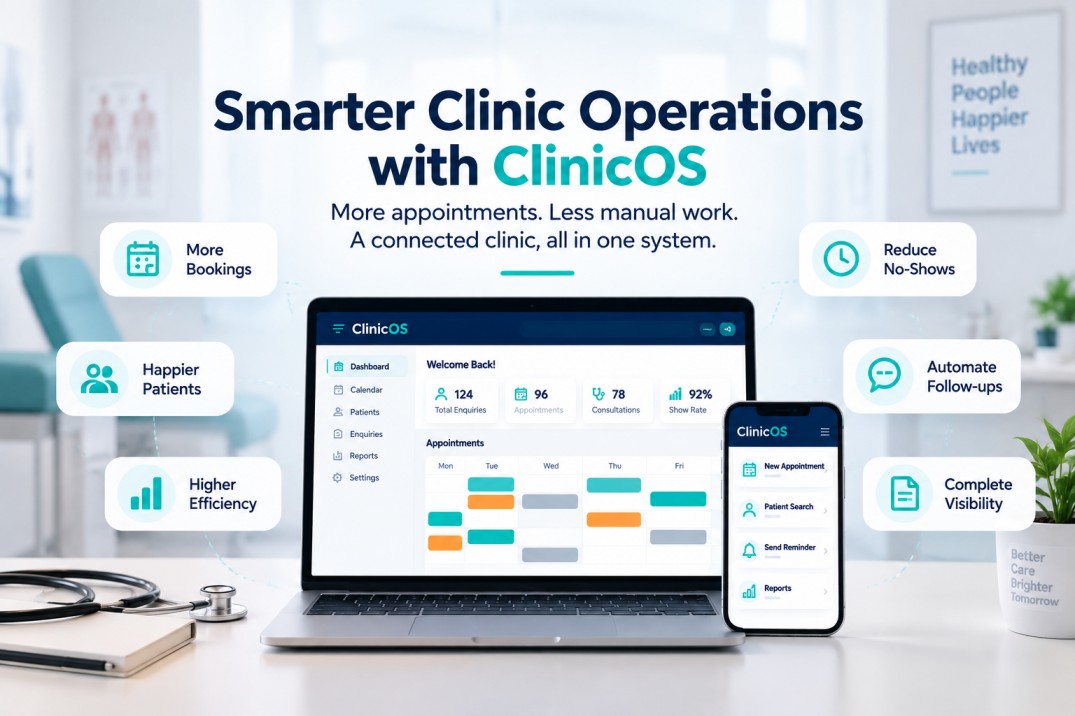
Following these guidelines is mostly a matter of knowing what goes out under your clinic’s name, on which channel, and who approved it. Touchstone ClinicOS brings clinic appointments, WhatsApp conversations, social media and Google Business Profile management into one platform.
For help with a clinic website or search visibility, see Touchstone Infotech’s SEO services.
This article is general information based on the NMC public notice dated 6 October 2026. It is not legal advice. For a specific post, campaign or notice, consult a medico-legal professional and the official text.