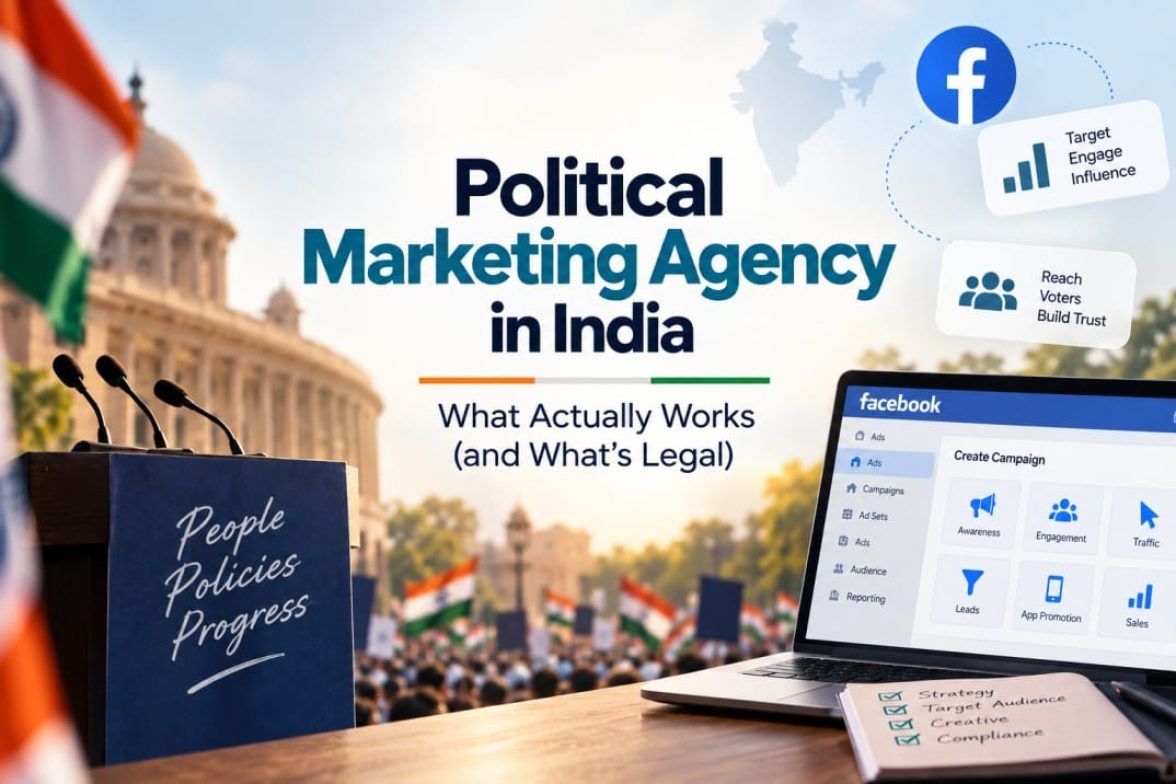

Search for a political marketing agency in India and every firm promises the same thing: victory. Most of their pages are a wall of service icons and round-number claims, fifty million impressions here, an eighty-five percent success rate there. Almost none explain the part that decides whether a campaign runs cleanly or collects a notice from the returning officer.
That part is the rules. This guide covers what these agencies actually do, what the law requires, what genuinely shifts voter behaviour, and how to tell a serious operator from a well-designed website.
The short version
- A political marketing agency runs the digital side of a campaign: strategy, paid ads, WhatsApp and SMS outreach, content, and reputation.
- Every political ad on electronic or social media needs MCMC pre-certification before it goes live.
- The 48-hour silence period and social media spend reporting both apply to digital, under the RP Act 1951.
- Constituency-level targeting and honest metrics matter more than national reach.
- The best filter when hiring is simple: does the agency lead with compliance, or with reach screenshots?
What a political marketing agency in India actually does
Strip away the jargon and the work falls into four areas.
1. Digital campaign strategy and messaging
The foundation is research and message discipline. Constituency study, opponent mapping, and the two or three themes a candidate will own for the whole campaign. A good agency turns a manifesto into a handful of lines a booth worker can repeat without a script, then keeps every poster, reel, and ad pointing back at those lines. Consistency makes a message stick. Scatter wastes a budget.
2. Paid media across Meta, Google, and YouTube
This is where reach is bought. Facebook and Instagram carry the bulk of constituency-level targeting, YouTube handles longer candidate films, and Google search captures people already looking for the candidate or the opponent. Handled well, Meta and Google Ads management puts the right message in front of the right pin code at the right moment. Handled carelessly, it burns money on impressions that were never going to vote in that seat. Every rupee spent here is also a reporting obligation, which most vendors leave out of the pitch.
3. WhatsApp, SMS, and direct voter outreach
WhatsApp is the workhorse of Indian campaigns. Broadcast lists, volunteer coordination, booth-level updates, and quick clarification when a rumour starts moving. It works only when contacts are collected with consent, which matters more now under the Digital Personal Data Protection Act 2023. SMS still earns its place for polling reminders and event alerts, where a plain message beats a designed one.
4. Reputation, sentiment monitoring, and rapid response
Someone has to watch what is being said and respond before it hardens. That means tracking search visibility and online reputation, monitoring trends, and catching misinformation early. In the final weeks this becomes a round-the-clock function, and it is the reason war rooms exist.
The compliance reality most agencies skip
Here is where almost every first-page competitor goes quiet. Political advertising in India is regulated, and the agency you hire effectively shares your campaign’s legal exposure. Four rules matter most.
| Rule | What it requires | Who and when |
|---|---|---|
| MCMC pre-certification | Every political ad on electronic or social media must be cleared before it runs | District MCMC for candidates, State MCMC for parties |
| Social handle disclosure | Declare your genuine social media accounts | In the nomination affidavit |
| 48-hour silence period (Sec 126, RP Act 1951) | No election matter in the 48 hours before polling closes, digital included | Platforms act on reported violations within 3 hours |
| Spend reporting (Sec 77(1), RP Act 1951) | Internet and social spend goes into the election expenditure statement | Filed within 75 days of assembly polls |
MCMC pre-certification for every political ad
The Election Commission of India requires that no political advertisement run on electronic or internet media, including social media, without prior clearance from the Media Certification and Monitoring Committee. Individual candidates apply to the District MCMC. Parties headquartered in a state apply to the State-level MCMC. The rule covers television, radio, e-papers, bulk SMS, voice messages, and platform ads alike. An agency that pushes creative live before certification is not saving you time, it is putting the candidate at risk.
Declaring authentic social media handles in the nomination affidavit
Candidates are now required to disclose their genuine social media accounts in the affidavit filed with their nomination. Handles run quietly off the books create a problem the moment a complaint is filed. A serious agency accounts for every official page and keeps the list clean.
The 48-hour silence period applies to digital too
Section 126 of the Representation of the People Act 1951 prohibits displaying election matter in the 48 hours before polling closes. This is not a print-and-TV relic. Under the Voluntary Code of Ethics agreed between the major platforms and the Commission, reported silence-period violations are acted on within three hours. Any campaign running automated posts needs its scheduling checked against this window. Ads and reels that fire on polling morning are a common and entirely avoidable mistake.
Reporting social media spend to the ECI
Under Section 77(1) of the same Act, money spent on internet and social media campaigning goes into the candidate’s or party’s expenditure statement, filed within 75 days of the completion of assembly polls. That figure includes payments to the platforms, content production costs, and the operational cost of running the accounts. A good agency hands you clean, itemised spend records that slot straight into that filing. A weak one hands you a screenshot of reach.
What actually moves votes versus what just looks good
Reach is the metric agencies love, because it is large, cheap to generate, and easy to screenshot. On its own it is close to meaningless.
| Looks good on a slide | Actually moves votes |
|---|---|
| National impression counts | Constituency-level reach and persuadable segments |
| Captions translated at the last step | Vernacular content built for the region |
| Follower growth | Message recall and sentiment shift |
| Total spend | Turnout, volunteer sign-ups, undecided movement |
Constituency-level targeting beats vanity reach. A million impressions spread across the country do nothing for a seat decided by forty thousand votes. The skill is narrowing spend to the constituency first, then to the persuadable segments inside it. Hyperlocal, constituency-level targeting is harder to set up and far more honest about results.
Vernacular content is strategy, not translation. A Hindi caption bolted onto an English creative is not the same as content built for a Hindi-speaking voter. Idiom, humour, format, and the platform mix all shift by region. Treating language as a last-step translation is exactly why so much political content feels hollow to the people it is meant to reach.
What a political digital campaign costs in India
There is no single number, and anyone who quotes one without asking about your seat is guessing. Cost depends on the size of the constituency, the length of the campaign, and how much of the budget is paid media versus content and team. A single assembly seat run for a few weeks sits in a very different band from a multi-phase state effort.
Rather than chase a figure, ask any agency to break its quote into three parts:
- Media spend that passes through to the platforms
- Content and production
- Agency retainer
If a firm cannot or will not separate those three, the quote is not one you can evaluate, and that is answer enough.
How to vet a political marketing agency
Questions to ask before you sign
- What is your MCMC pre-certification process, and who manages it?
- How do you record spend for our Section 77(1) expenditure statement?
- Can you show constituency-level results from past work, not national reach?
- Who owns the ad accounts and WhatsApp assets, us or you?
Red flags
- A guaranteed win. No one can promise that, and the claim itself signals inexperience.
- No mention of compliance anywhere in the pitch.
- Headline stats with nothing behind them, the fifty-million-reach and ninety-percent-success variety.
- Reluctance to hand over account access when the engagement ends.
The right partner is not the one with the loudest numbers. It is the one who can run a campaign that stays inside the rules and still reports something real when the polling is done.
Frequently asked questions
Is digital marketing legal for political campaigns in India?
Yes. Digital campaigning is legal and widely used. It is regulated, though. Political ads on electronic and social media must be pre-certified by the MCMC, spend must be reported to the Election Commission, and the Model Code of Conduct applies online just as it does offline.
Do political ads need ECI approval before they go live?
Yes. The Election Commission requires MCMC pre-certification for every political advertisement on electronic and internet media, including social platforms, before release. Candidates apply to the District MCMC and parties to the State-level MCMC.
How much does a political digital campaign cost in India?
It depends on the constituency size, campaign length, and the split between paid media, content, and team. Ask for the quote to be broken into media spend, production, and retainer so you can compare agencies on a like-for-like basis.
Which platforms work best for Indian political campaigns?
WhatsApp for direct voter and volunteer communication, Facebook and Instagram for targeted reach, YouTube for longer video, and Google for search and reputation. The right mix varies by region and voter profile.
What is MCMC pre-certification?
The Media Certification and Monitoring Committee reviews and certifies political advertisements before they run. It operates at district and state levels and clears ads across TV, radio, print, e-papers, bulk messaging, and social media.
Can you run political ads during the 48-hour silence period?
No. Section 126 of the RP Act 1951 bars election matter in the 48 hours before polling closes, and this applies to digital. Platforms act on reported violations within three hours under the Voluntary Code of Ethics.
How is political ad spend reported to the Election Commission?
Under Section 77(1) of the RP Act 1951, internet and social media spend, including platform payments, content costs, and account operation, must be included in the expenditure statement filed within 75 days of the completion of assembly polls.
Work with Touchstone
Running for a seat or managing a campaign? Touchstone builds and runs political digital campaigns that stay inside Election Commission rules and report against real voter metrics, not reach screenshots. From MCMC-ready creative to constituency-level targeting and clean expenditure records, the work is set up to hold up to scrutiny.
See how we work with parties and candidates at our political campaign services, or get in touch for a campaign consult.