
A prospective patient searches “skin clinic near me” on a Sunday evening. She finds a clinic that looks right, taps the number, and calls. No one answers, because the front desk closed hours ago. She sends a WhatsApp message instead. It stays unread until Tuesday morning, buried under fifty other chats. By the time someone replies, she has already booked with a different clinic that answered in four minutes. The first clinic never found out it lost her.
Nobody there was careless. The team was busy with patients in the chair, which is exactly where their attention should be. The problem is structural. Enquiries arrive at all hours, across channels no single person is watching, and the tools that receive them do not talk to each other. This is the gap that clinic marketing automation software is built to close.
Clinic marketing automation software captures patient enquiries from every channel a clinic uses, replies quickly, follows up, and books appointments, without the front desk handling each step by hand. It manages what happens outside the consultation room, from enquiry to communication to booking to reminders, and it works alongside your clinic management or EMR software rather than replacing it.
Key takeaways
- Clinic marketing automation software manages what happens outside the consultation room: capturing enquiries from every channel, replying fast, following up, booking, and reminding.
- It is not the same as clinic management or EMR software, which handles records, prescriptions, and billing. Most clinics need both, and the two run side by side.
- Appointment reminders have a measurable effect: a 2016 systematic review and meta-analysis in BMJ Open found no-shows dropped from 21% to 15% with electronic notifications, about a quarter fewer.
- In India, most enquiries now arrive by WhatsApp, phone, Google, and Instagram, so automation has to unify those channels and respect patient consent.
- Automation supports staff and reduces repetitive work. It does not replace clinical judgement, patient care, or the human side of a clinic.
What is clinic marketing automation software?
Clinic marketing automation software is a system that captures, manages, and follows up on patient enquiries automatically, from the first message to a confirmed appointment. It sits across the channels patients actually use, replies without delay, keeps every enquiry in one view, and prompts the right follow-up at the right time.
The important distinction is scope. This category handles the work outside the consultation room: enquiry capture, communication, qualification, follow-up, booking, reminders, and reputation. It does not manage clinical records, prescriptions, or billing. That is the job of clinic management or EMR software, and the two are meant to run together, not compete.
Your EMR takes over once the patient is in front of the doctor. Marketing automation is everything that gets them to that point, and everything that brings them back afterwards.
Where Indian clinics lose patient enquiries
Ask most clinic owners where their enquiries come from and the honest answer is “everywhere”. A single patient might see an Instagram reel, check Google reviews, message on WhatsApp, and call the reception, all before deciding. Each of those touchpoints usually lives in a different place, owned by a different person, with no shared record.
That fragmentation is where enquiries leak. The common failure points look like this:
- A missed call during a busy clinic hour that no one calls back.
- A WhatsApp message that arrives after hours and is never seen.
- A website form that lands in an inbox nobody checks daily.
- A Google Business Profile message that goes unnoticed because the profile is rarely opened.
- A follow-up that depends entirely on one receptionist remembering to do it.
Two deeper problems sit under these. First, front-desk dependency: when one person holds the whole enquiry process in their head, a sick day or a resignation takes the process with them. Second, no visibility into sources: without tracking, a clinic cannot tell whether its patients came from Google, a referral, or a paid campaign, which makes every marketing rupee a guess.
The result is quiet and expensive. Enquiries that would have converted simply disappear, and the clinic keeps spending to generate new ones.
How clinic marketing automation works: the journey from enquiry to appointment
Underneath, clinic marketing automation software does one thing: it turns a scattered, manual process into a single connected path. Every enquiry, whatever channel it came from, enters the same flow and moves forward on its own until a human decision is genuinely needed. In practice, the path looks like this:
- Patient discovers the clinic through Google, Instagram, a referral, or an ad.
- An enquiry arrives by WhatsApp, call, website form, or Google Business Profile.
- The enquiry is captured in one place and tagged by source.
- An instant acknowledgement is sent, so the patient knows they were heard.
- AI assists with common questions and basic qualification.
- An automated follow-up goes out if the patient falls quiet.
- A booking link is shared and the appointment is scheduled.
- A confirmation is sent, followed by reminders before the visit.
- The consultation takes place.
- A post-visit follow-up and a review request close the loop.
The value is not any single step. It is that no step depends on someone remembering to do it. A patient who messages at 11pm still gets an instant reply and a booking link. A patient who does not respond still gets a gentle follow-up two days later. The clinic stops losing people to silence.
The automations that matter most for clinics
Not every feature earns its place. These are the ones that consistently change outcomes for Indian clinics.
Centralised enquiry capture. Every enquiry from every channel lands in one inbox, so nothing depends on which staff member happened to see it. This alone removes most of the “we never saw the message” losses.
Instant acknowledgement and automated follow-up. A patient who hears back within minutes is far more likely to stay with your clinic than one who waits a day. When a patient goes quiet, scheduled follow-ups re-engage them without anyone chasing manually.
Missed-call recovery. A missed call is a patient trying to reach you. Automation can trigger an instant WhatsApp or text to every missed call, turning a lost ring into a live conversation.
Enquiry qualification. Simple questions sort a genuine appointment request from a general query or a wrong number, so staff spend time on the enquiries that matter.
Lead nurturing. Many patients are not ready to book on day one. A light sequence of useful messages keeps the clinic present until they are, without becoming a nuisance.
Booking, confirmations, and reminders. Patients receive a booking link, an immediate confirmation, and reminders before the visit. This is the part of automation with the clearest, best-documented effect, covered in its own section below.
No-show rebooking. When a patient does miss a visit, an automated rebooking prompt recovers the appointment instead of writing it off.
Enquiry pipeline management. A simple pipeline shows every enquiry and its stage, from new to booked to visited, so the clinic can see exactly where people drop off.
WhatsApp automation for clinics
Can clinics automate WhatsApp follow-ups? Yes, and in India it is often the single most useful automation a clinic can set up, because WhatsApp is where most patients prefer to talk.
Automated WhatsApp workflows can send an instant reply to a new enquiry, share a booking link, confirm an appointment, send reminders, and follow up after a visit. Because patients read WhatsApp far more reliably than email, these messages land where they will actually be seen.
Consent and communication controls matter here more than anywhere else. When choosing and configuring clinic marketing automation software, a clinic should be clear about how patient contact details are collected, what each patient has agreed to receive, how communication preferences are managed, and whether staff can pause or stop automated messages when needed. Clinics using WhatsApp, SMS, or other channels should set up their workflows in line with applicable Indian data-protection requirements, including the Digital Personal Data Protection Act, and with the policies of the messaging platforms they use.
There is also a line worth drawing inside the system itself. Operational messages, such as appointment confirmations and reminders, are not the same as promotional campaigns. A patient agreeing to receive a reminder for their booked visit has not automatically agreed to ongoing marketing. Good software lets a clinic keep those two separate and honour them.
AI receptionist and chatbot: what it can and cannot do
What is an AI receptionist for a clinic? It is an automated assistant that answers common patient questions, helps with booking, and qualifies enquiries, over chat or WhatsApp, so routine questions do not wait for a free staff member.
In practice, an AI receptionist can respond to approved frequently asked questions such as timings, location, services offered, and what to bring. It can guide a patient toward booking, collect basic details, and hand the conversation to a human the moment anything falls outside its scope. Staff can take over at any point, and they should be able to.
The limits are just as important. An AI receptionist does not give medical advice, does not diagnose, and does not replace a doctor or a trained team member. It answers logistics and common questions, and it buys your staff time. Anything clinical belongs with a person. Used this way, AI reduces repetitive front-desk work and keeps responses consistent, without pretending to be something it is not.
Reducing no-shows with confirmations and reminders
Can marketing automation reduce clinic no-shows? The evidence says yes. A 2016 systematic review and meta-analysis published in BMJ Open, covering 21 studies and more than 16,000 patients, found that no-show rates fell from about 21% among patients who received no electronic notification to about 15% among those who did, roughly a quarter fewer missed appointments (Robotham et al., 2016). The same review found that multiple reminders worked better than a single one.
Here is what that looks like in a clinic’s numbers. Treat it as an illustration, not a measured result:
- Before automation: 100 appointments booked in a month, 18 missed, an 18% no-show rate.
- After consistent reminders and easy rescheduling: 100 appointments booked, 12 missed, a 12% no-show rate.
That is 6 more appointments kept every month from the same bookings, without spending a rupee more on marketing. Across a year, the recovered chair time adds up quickly.
Touchstone worked with a clinic in Chennai to put this into practice, implementing automated appointment booking, AI-assisted responses to common questions, and appointment reminders. The objective was practical: reduce repetitive front-desk work, keep responses consistent, and lower the risk of missed appointments. The point of reminders is not to nag. It is to make it easy for a patient to remember, confirm, or reschedule, which is what turns a booking into a kept appointment.
Knowing where your patients come from: reviews, Google Business Profile, and attribution
Marketing automation is not only about individual patients. It is also how a clinic learns which of its efforts actually produce appointments.
Review and reputation workflows can ask satisfied patients for a Google review at the right moment, which lifts a clinic’s local visibility over time. Managing a clinic’s Google Business Profile management well, keeping information current and responding to reviews, is often the difference between showing up in the local map results and being invisible there. For clinics, the profile is frequently the first thing a nearby patient sees.
Attribution is the quieter win. When every enquiry is tagged by source, a clinic can finally answer the question that used to be a guess: which channel brought this patient? That turns marketing from an act of faith into a set of decisions. If Google and referrals produce most booked appointments and a paid campaign produces mostly tyre-kickers, the budget can move accordingly. This is where automation connects to broader local SEO for clinics, because being found and measuring what happens next are two halves of the same job. For the specific mechanics of getting your contact details right in local search, this guide on adding your business phone number to Google Business Profile is a practical starting point.
Marketing automation for multi-location clinics
How can multi-location clinics manage leads centrally? With a shared system where every branch’s enquiries land in one place, are routed to the right location, and can be seen from a single dashboard.
For a clinic with two or ten branches, the fragmentation problem multiplies. Each location has its own front desk, its own WhatsApp number, and its own way of doing things, and the owner has no single view of what is happening. Marketing automation gives a central inbox and pipeline across all branches, routes each enquiry to the correct location automatically, and reports performance branch by branch. An owner can see, at a glance, which location responds fastest, which has the most no-shows, and where enquiries are slipping. That visibility is nearly impossible to get by hand once a clinic grows past a single site.
Clinic marketing automation vs clinic management and EMR software
What is the difference between clinic CRM and clinic management software? Clinic CRM and marketing automation manage enquiries, communication, and marketing, the work before and around a visit. Clinic management or EMR software manages the clinical side: patient records, prescriptions, billing, and reports. They solve different problems.
| Clinic marketing automation software | Clinic management / EMR software | |
|---|---|---|
| Main job | Capture and convert enquiries into appointments | Manage clinical records and operations |
| Focus | Outside the consultation room | Inside the consultation room |
| Handles | WhatsApp, calls, forms, follow-ups, reminders, reviews, lead sources | Patient history, prescriptions, billing, inventory |
| Goal | More booked and kept appointments | Accurate records and smooth clinical workflow |
| Examples of category | Marketing and enquiry platforms, CRMs | Practo, EasyClinic, and similar EMR or PMS tools |
Can clinic marketing automation work with Practo or my existing clinic software? Yes. The two are complementary. A clinic can keep using Practo, EasyClinic, or whatever clinical software it relies on, and add marketing automation on top to handle enquiries and communication. There is no need to rip anything out. The automation layer manages the patient’s journey to the door, and the clinical software takes over once they are inside.
What to look for when choosing clinic marketing automation software in India
Is marketing automation useful for a single-doctor clinic? Often more than for a large one, because a solo practice has the least spare capacity to chase enquiries manually. The right tool acts like a reliable extra team member who never forgets a follow-up.
When comparing options, weigh these against your clinic’s reality:
- Channels that match your patients. WhatsApp is non-negotiable for most Indian clinics. Make sure it is handled properly, not as an afterthought.
- Consent and communication controls. Confirm the software lets you manage what patients agreed to, separate operational messages from promotions, and stop automation when needed, in line with the Digital Personal Data Protection Act and platform policies.
- Works with your existing clinical software. It should sit beside your EMR, not force you to replace it.
- Honest AI. The assistant should answer approved questions and hand off to staff cleanly, without overclaiming.
- Source tracking and reporting. If you cannot see where enquiries come from, you cannot improve your marketing.
- Multi-location support, if you have or plan more than one branch.
- Local support and setup. A system configured for Indian clinics, with help available in your time zone, beats a generic global tool you have to force-fit.
ClinicOS by Touchstone Infotech
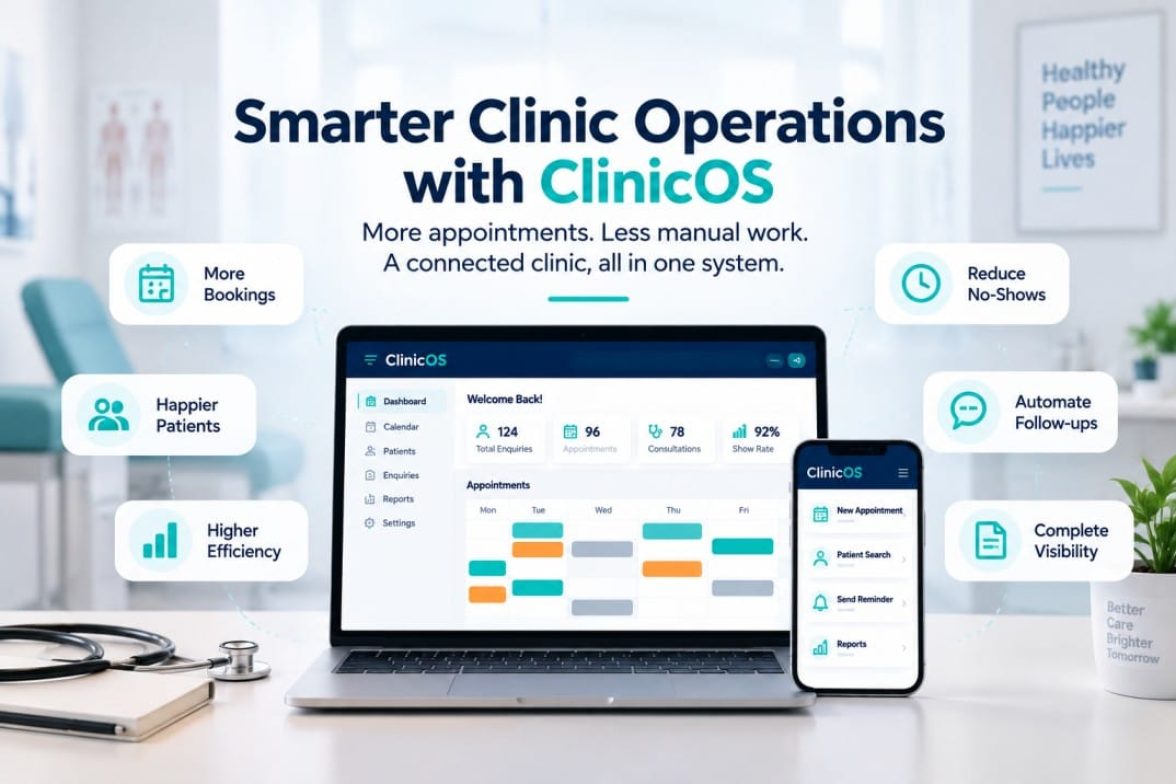
Once the category makes sense, the real question is how to run all of it from one place instead of a dozen. That is what ClinicOS, developed by Touchstone Infotech, is built to do.
ClinicOS is one operating system for clinic growth and patient enquiry management. It brings together new enquiries, lead management, WhatsApp communication, appointment management, automated follow-ups, AI-assisted responses, lead nurturing, social media, Google Business Profile activity, reviews and reputation, reporting, and multi-branch management, in a single connected platform designed for how clinics in India actually work.
ClinicOS is not an EMR or a medical-records system, and it does not replace the clinical software a practice already uses. Clinics can continue running Practo, EasyClinic, or their existing clinic software for records and clinical workflow. ClinicOS focuses on everything outside the consultation room: the path from enquiry to communication to follow-up to booking to reminders to the appointment, and then to continued engagement, reviews, and marketing.
Because it comes from a growth and automation company that works across marketing and clinic enquiry workflows every day, ClinicOS is shaped around real front-desk problems rather than software theory. It fits clinics of many kinds, from skin and aesthetic practices to hair transplant, IVF, physiotherapy, and multi-speciality clinics, and it stays useful whether a clinic has one location or several.
Where this leaves you
The clinic that answered that Sunday-evening WhatsApp in four minutes did not have a bigger team. It had a better system. Clinic marketing automation software is how a busy practice responds like that consistently, without burning out its front desk, while keeping patient care exactly where it belongs, with people. Start by fixing the leak between enquiry and appointment. The patients are already reaching out. The task is making sure none of them are lost on the way in.
Frequently asked questions
What is clinic marketing automation software?
It is a system that captures patient enquiries from channels like WhatsApp, phone, Google, and website forms, replies instantly, follows up, books appointments, and sends reminders, automatically. It manages marketing and enquiry work, not clinical records.
What is the difference between clinic CRM and clinic management software?
Clinic CRM and marketing automation handle enquiries, communication, and marketing, the work outside the consultation room. Clinic management or EMR software handles clinical records, prescriptions, and billing. Most clinics use both together.
Can clinic marketing automation work with Practo or my existing clinic software?
Yes. It is designed to run alongside clinical software such as Practo or EasyClinic. The automation layer manages the patient’s journey up to the appointment, and your existing software handles the clinical side.
Can clinics automate WhatsApp follow-ups?
Yes. Clinics can send automated instant replies, booking links, confirmations, reminders, and post-visit messages over WhatsApp, provided patient consent and platform policies are respected.
What is an AI receptionist for a clinic?
An AI receptionist is an automated assistant that answers approved common questions, helps patients book, and qualifies enquiries over chat or WhatsApp. It hands off to human staff whenever needed and does not give medical advice or diagnoses.
Can marketing automation reduce clinic no-shows?
Reminders have a measurable effect. A 2016 systematic review and meta-analysis in BMJ Open (Robotham et al.) found no-show rates fell from about 21% to about 15% with electronic notifications, roughly a quarter fewer missed appointments.
Is marketing automation useful for a single-doctor clinic?
Yes, often especially so, because a solo practice has the least spare time to chase enquiries by hand. Automation handles instant replies and follow-ups that would otherwise be missed.
How can multi-location clinics manage leads centrally?
With a shared system that collects every branch’s enquiries in one place, routes each to the correct location, and reports performance branch by branch, giving the owner a single view across all sites.
Book a personalised ClinicOS demo
See how ClinicOS could fit your clinic’s existing enquiry and appointment process. Book a demo with Touchstone Infotech and see how enquiries from WhatsApp, calls, and Google can flow into one system, from first message to booked appointment.