
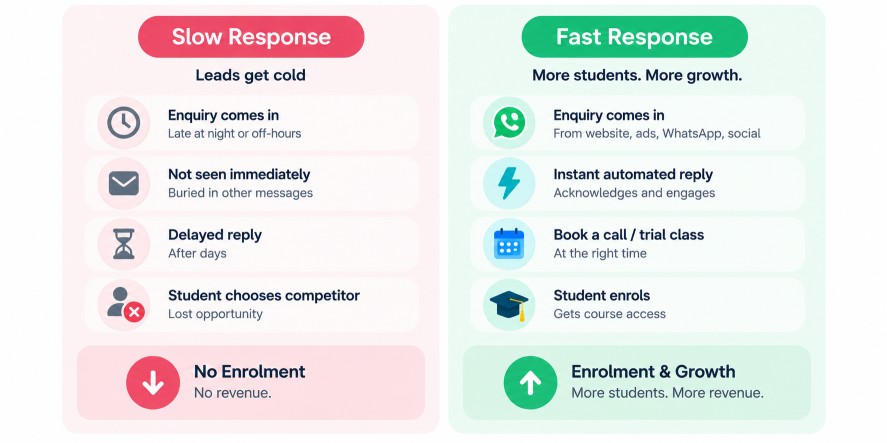
Someone watches your reel at 11pm, likes what they see, and sends a message: “Is the next batch still open?” It lands in an Instagram inbox nobody checks after hours. The next morning it is buried under forty other notifications. By the time a team member scrolls back to it two days later, that person has already paid for a competitor’s course, the one that replied the same night. You never find out you lost them. There is no missed-enquiry report. They simply never existed as far as your records are concerned.
Nobody was careless. The team was teaching, which is where their attention should be. The problem is structural. Enquiries arrive at all hours, across channels no single person is watching, and the tools that receive them do not talk to each other. WhatsApp does not know what your website form captured. Your payment app does not know who your course tool already enrolled. That gap is where students and revenue quietly leak out, and it is what an all-in-one platform for a coaching business is built to close.
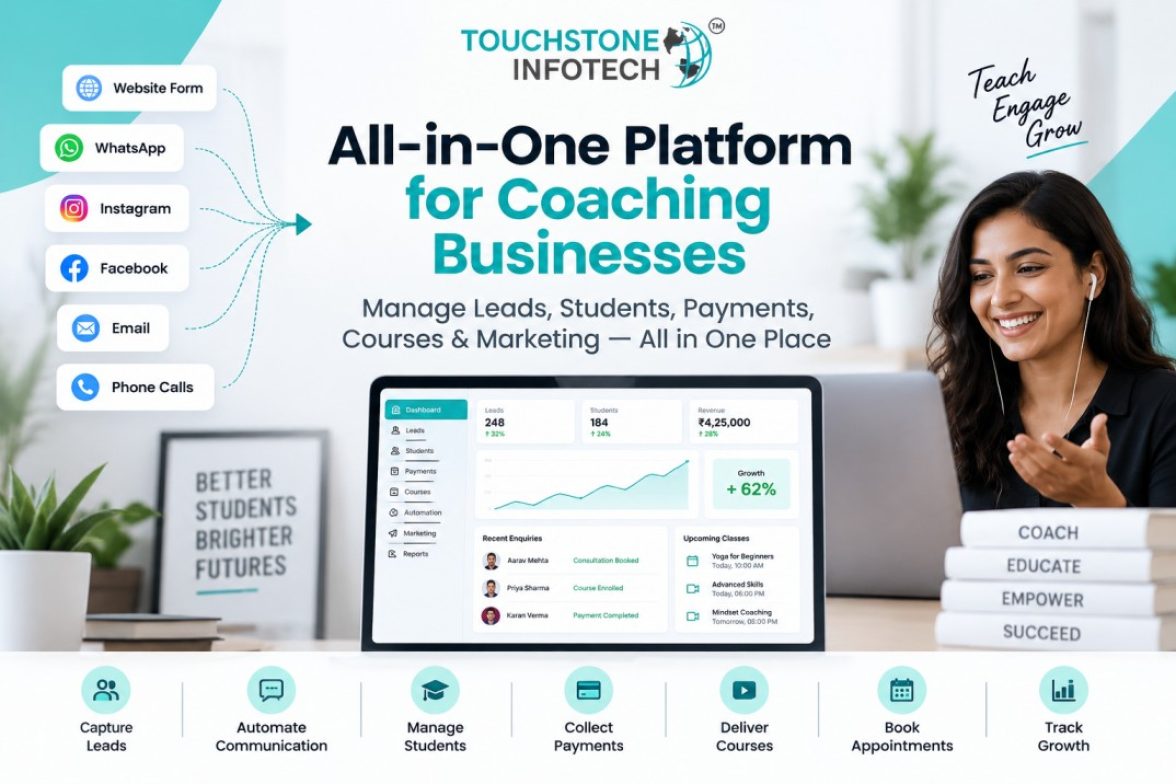
An all-in-one platform for a coaching business is a single connected system that combines a CRM, communication (WhatsApp, email, SMS, social), sales pipelines, online courses, payments, appointment booking, landing pages, marketing automation, and analytics. Instead of running separate apps that do not share data, everything a student does lives in one record, so one action, such as a payment, can automatically update the record, grant course access, and trigger the next message. It manages the business side of teaching, not the teaching itself.
Key takeaways
- An all-in-one coaching platform unifies lead management, student records, communication, payments, courses, and marketing so nothing has to be copied by hand between apps.
- Speed matters more than most owners think. Harvard Business Review’s audit of 2,241 firms found that contacting a lead within an hour made it nearly seven times more likely to qualify than waiting even one hour longer, yet the average first response was 42 hours.
- A CRM and an LMS are not the same thing. A CRM wins and keeps students; an LMS teaches them. Most coaching businesses need both, connected.
- WhatsApp, Instagram, Google, and website forms all feed enquiries into the business now, so automation has to unify those channels and respect consent.
- Buying the software is the easy part. The result comes from configuring it around your real student journey, which is where implementation matters most.
What is an all-in-one platform for a coaching business?
An all-in-one platform for a coaching business is one system that runs the commercial and operational side of an education business, from the first enquiry to the last renewal, instead of a stack of apps stitched together. The point is not that it does everything a specialist tool does. The point is that the parts share the same data, so information entered once is available everywhere.
In practice it brings together a CRM to hold every lead and student, a shared inbox for WhatsApp, email, SMS, and social, sales pipelines to track who is close to enrolling, course and membership hosting, payments, appointment booking, landing pages and forms, marketing campaigns, analytics, and an AI assistant. What makes it a platform rather than a bundle is the chain: an enquiry becomes a lead, a lead books a call, a payment enrolls a student, an enrolment grants course access, and every step shows up in one report. No handoffs, no copying.
Where coaching businesses lose enquiries
Ask most owners where their leads come from and the honest answer is “everywhere”. A prospect might see an Instagram ad, check reviews on Google, message on WhatsApp, and fill a form on your site, all before deciding. Each of those touchpoints usually lives in a different place, owned by a different tool, with no shared record.
That fragmentation is where enquiries leak. The common failure points look like this:
- A WhatsApp message that arrives after hours and is never seen.
- A website form that lands in an inbox nobody checks daily.
- A comment or DM that gets a like instead of a reply.
- A free-class registrant who never gets a follow-up.
- A follow-up that depends entirely on one person remembering to do it.
Two deeper problems sit under these. First, dependency on one person: when the one who “handles the messages” is on leave, the process leaves with them. Second, no visibility into sources: without tracking, you cannot tell whether a paying student came from Google, a referral, or a paid campaign, which makes every marketing rupee or dollar a guess. The result is quiet and expensive. Enquiries that would have enrolled simply disappear, and you keep spending to replace them.
How it works: the journey from enquiry to enrolment
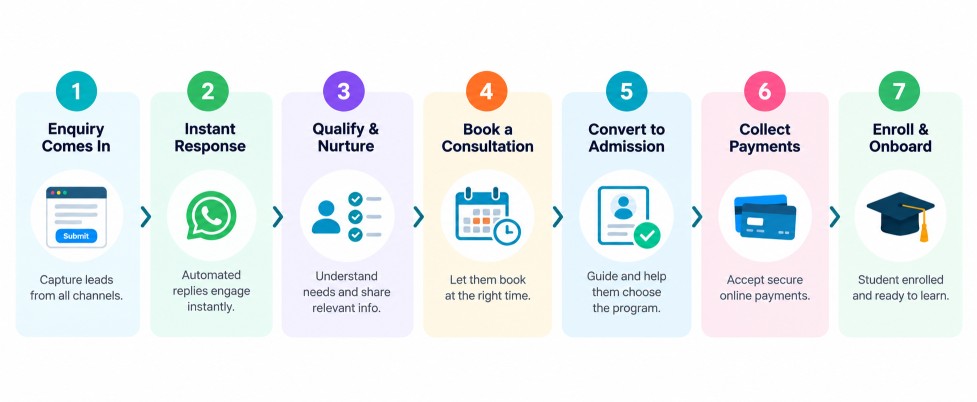
Underneath, an all-in-one platform does one thing: it turns a scattered, manual process into a single connected path. Every enquiry, whatever channel it came from, enters the same flow and moves forward on its own until a human decision is genuinely needed. In practice the path looks like this.
1A prospect discovers you through an ad, a search result, a referral, or a social post.
2They land on a page built for that program and read the offer.
3They enquire by form, WhatsApp, or DM, and the source is captured automatically.
4The enquiry becomes a lead in one CRM, tagged and visible to the whole team.
5An instant reply goes out, so the person knows they were heard.
6An AI assistant handles common questions and basic qualification.
7A booking link is shared and a consultation or demo is scheduled.
8After the call, the student pays through a connected gateway.
9The payment enrolls them and grants access to the right course.
10Class reminders, progress nudges, a review request, and the next offer follow on their own.
The value is not any single step. It is that no step depends on someone remembering to do it. The person who messages at 11pm still gets an instant reply and a booking link. The one who does not respond still gets a gentle follow-up two days later. You stop losing people to silence.
The automations that matter most
Not every feature earns its place. These are the ones that consistently change outcomes for coaching and education businesses.
Centralised enquiry capture. Every enquiry, from every channel, lands in one inbox and one pipeline, so nothing depends on which team member happened to see it. This alone removes most of the “we never saw the message” losses.
Instant reply and automated follow-up. A prospect who hears back within minutes is far more likely to stay with you than one who waits a day. When a lead goes quiet, a scheduled sequence re-engages them without anyone chasing manually.
Missed-enquiry recovery. A missed call or an ignored DM is a student trying to reach you. Automation can trigger an instant WhatsApp or message back, turning a lost contact into a live conversation.
Lead qualification. A few simple questions separate a serious enquiry from a casual one or a wrong fit, so your team spends time on the people most likely to enroll.
Nurture for the not-ready. Most people are not ready to buy on day one. A short sequence of useful messages keeps you present until they are, without becoming a nuisance.
Booking, confirmations, and reminders. Prospects self-book consultations, students get class reminders, and both sides receive confirmations, all without manual scheduling. This is where no-shows drop.
Payment and enrolment. A successful payment can record itself, update the student record, and unlock course access automatically, so nobody grants access by hand after checking who paid.
Pipeline visibility. A simple board shows every enquiry and its stage, from new to enrolled, so you can see exactly where people drop off and fix it.
WhatsApp automation for coaching businesses
Can coaching businesses automate WhatsApp follow-ups? Yes, and it is often the single most useful automation to set up, because WhatsApp is where most students actually prefer to talk. Through the WhatsApp Business API, an automated workflow can send an instant reply to a new enquiry, share a booking link, confirm an enrolment, send class reminders, and follow up after a session. Because people read WhatsApp far more reliably than email, these messages land where they will be seen.
Consent and communication controls matter more here than anywhere else. When you configure a platform, be clear about how contact details are collected, what a student has agreed to receive, how they can opt out, and whether staff can pause automated messages when needed. Businesses using WhatsApp, SMS, or email should set up workflows in line with the data-protection rules that apply to them and with the policies of the messaging platforms they use.
There is also a line worth drawing inside the system itself. Operational messages, such as class reminders and payment confirmations, are not the same as marketing campaigns. A student who agreed to reminders for their course has not automatically agreed to ongoing promotions. Good setup keeps those two separate and honours the difference.
The AI assistant: what it can and cannot do
What is an AI assistant for a coaching business? It is an automated assistant that answers common questions, helps with qualification, and books calls over chat or WhatsApp, so routine enquiries do not wait for a free team member. Someone asking about fees, start dates, or the syllabus at midnight gets a useful reply immediately and can be booked for a call if they are a fit.
The limits are just as important. An AI assistant does not teach, does not replace a mentor or a trainer, and should hand off to a human the moment a question goes beyond its scope or a prospect wants real depth. Used this way, it reduces repetitive front-desk work and keeps responses consistent, without pretending to be something it is not. In one setup we ran, the assistant was answering new enquiries in about five seconds, at any hour, which is a standard no human team can hold on its own.
Why fast follow-up wins more students
Does responding faster actually enroll more students? The evidence points strongly that way. Harvard Business Review’s 2011 audit of 2,241 companies, “The Short Life of Online Sales Leads”, found that firms which tried to contact a lead within an hour were nearly seven times more likely to qualify it than those that waited even one more hour, and more than sixty times more likely than those that waited a full day. The same audit found the average first response was 42 hours. Most businesses are slow, which means simply being fast puts you ahead of nearly everyone competing for the same student.
Here is what that can look like inside a coaching business. Treat these as an illustration, not a measured result.
| Scenario | What happens |
|---|---|
| Before automation | 50 enquiries a month, replied to when someone has time, many after hours or the next day. A share go cold before anyone responds. |
| After instant reply and follow-up | The same 50 enquiries get an immediate acknowledgement and a scheduled follow-up, so more reach a real conversation instead of silence. |
The numbers are not the promise. The behaviour is. To put this into practice, Touchstone worked on the lead flow for one coaching client, rebuilding how enquiries were captured, replied to, and followed up. After that setup, the business reached roughly a 5x return on ad spend, cut a large share of its manual follow-up work, around 14 hours of it, and used an AI assistant to answer new enquiries in about five seconds. That is one client’s result from one configuration, not a guarantee that every business will see the same. The gain came from the workflow design, not from the software existing.
Knowing where your students come from
An all-in-one platform is not only about individual enquiries. It is also how you learn which of your marketing efforts actually produce paying students.
Attribution is the quiet win. When every lead is tagged with its source, you can finally answer the question that used to be a guess: which channel brought this student? That turns marketing from an act of faith into a set of decisions. If Instagram and referrals produce most enrolments while a paid campaign produces mostly clicks, the budget can move accordingly. This connects to broader lead generation and AI-powered marketing, because being found and measuring what happens next are two halves of the same job.
Reviews and reputation belong here too. A satisfied student who just finished a program is the best time to ask for a Google review, and the platform can request it automatically. For local education businesses, such as a tutoring centre or a training institute, a well-managed Google Business Profile is often the first thing a nearby prospect sees, so a steady flow of fresh reviews supports both trust and local search visibility. Your social media activity becomes measurable in the same way, since ad leads feed the same pipeline as everything else.
Multi-batch and multi-location coaching
How can a business with several batches or locations manage leads centrally? With a shared system where every branch’s and every batch’s enquiries land in one place, are routed to the right owner, and can be seen from a single dashboard. A tutoring chain with three centres, or a course creator running five cohorts at once, has the same fragmentation problem multiplied. A central inbox and pipeline across all of them, with each enquiry routed to the correct team, and reporting broken down by branch or batch, gives the owner one view of what is happening. That visibility is nearly impossible to get by hand once a business grows past a single batch.
CRM vs LMS: do you need both?
What is the difference between a CRM and an LMS? A CRM and an LMS solve different problems, and the confusion between them costs businesses money. A CRM manages people, sales, communication, and marketing, the work of winning and keeping students. An LMS manages learning content, lessons, assessments, progress, and certification, the work of teaching them.
| CRM | LMS |
|---|---|
| Manages people and relationships | Manages learning content |
| Lead generation and sales pipelines | Lessons and modules |
| Communication and marketing | Assessments and quizzes |
| Appointments and automation | Progress tracking |
| Retention and follow-up | Certification |
A coaching business that both sells programs and delivers structured courses usually needs both functions, and the important part is that they connect, so an enrolment in the CRM grants access in the LMS and course activity flows back into the student record. Many all-in-one platforms include course and membership features that cover common LMS needs, which is enough for a lot of coaching businesses. Programs with heavy assessment or formal accreditation may still want a dedicated LMS integrated alongside the CRM. There is no need to rip anything out; the automation layer manages the journey to enrolment, and the learning tool takes over once a student is inside.
CoachOS by Touchstone Infotech
Once the category makes sense, the real question is how to run all of it from one place instead of a dozen. That is what CoachOS, built by Touchstone Infotech, is designed to do.
CoachOS is one connected system for coaching and education businesses. It brings together enquiry capture, lead management, WhatsApp and email communication, appointment booking, automated follow-ups, AI-assisted responses, lead nurturing, courses and membership access, payments and enrolment, social media and reviews, reporting, and multi-batch management, configured around how a real education business runs.
It is not a piece of software we sell and walk away from. Touchstone designs, configures, integrates, and implements the system around your existing courses, team, and student journey, using CRM, marketing automation, communication, payments, booking, analytics, and AI technologies together as one operation. We map your process first, build the pipeline and automations to match, connect your payment gateway, calendars, WhatsApp, and ad platforms, train your team, and refine it once real enquiries start flowing. Because that work is what decides the outcome, not the presence of another app.
Where this leaves you
The course that answered that 11pm message the same night did not have a bigger team. It had a better system. An all-in-one platform is how a busy coaching business responds like that consistently, without one person burning out holding the whole enquiry process in their head. Start by fixing the leak between enquiry and enrolment. The students are already reaching out. The task is making sure none of them are lost on the way in.
Frequently asked questions
What is an all-in-one platform for a coaching business?
An all-in-one platform for a coaching business is a single connected system that combines a CRM, communication, sales pipelines, online courses, payments, appointments, landing pages, marketing automation, and analytics, so leads, students, and revenue are managed in one place instead of across separate tools.
What is the difference between a CRM and an LMS?
A CRM manages people, sales, communication, and marketing. An LMS manages learning content, lessons, assessments, and certification. A CRM wins and keeps students; an LMS teaches them. Many coaching businesses use both and connect them.
Can a CRM manage online courses?
Many all-in-one platforms include course and membership features, so one system can manage the sales relationship and host the course content. Businesses with heavy assessment or accreditation needs may connect a dedicated LMS instead.
Can WhatsApp be integrated with a coaching CRM?
Yes. Through the WhatsApp Business API, conversations appear in the same inbox as email and SMS, and automated messages such as instant replies, reminders, and follow-ups can be sent on WhatsApp, provided student consent and platform policies are respected.
Can class reminders and payments be automated?
Yes. Class reminders can be sent automatically to a batch or an individual before each session. When a student pays through a connected gateway such as Razorpay or Stripe, the payment can record itself, update the student record, and unlock course access without manual steps.
Can students book consultations online?
Yes. Prospects and students can book consultations or demos through an online booking tool that shows real availability, syncs with your calendar, and sends automatic reminders to reduce no-shows.
Can AI respond to student enquiries?
Yes. An AI assistant can answer common questions about fees, schedules, and courses instantly, qualify leads, and book calls at any hour, while handing complex or high-intent conversations to a human.
Can Facebook and Instagram enquiries be centralised?
Yes. Lead-form submissions and messages from Facebook and Instagram can be routed into the same CRM and inbox as website and WhatsApp enquiries, so every conversation lives in one place.
Can a coaching CRM track lead sources?
Yes. Each lead can be tagged with its source, so you can see which ads, posts, or referrals produce paying students and move budget toward what works.
Can it work with my existing tools?
Usually yes. Most platforms connect to common tools such as payment gateways, calendars, and ad platforms through native integrations, so you can keep the specialist tools you rely on rather than replacing everything.
How long does implementation take?
It depends on the complexity of your workflows, the number of integrations, how much existing data needs migrating, and how much automation you want. A simple setup is faster than a multi-course business with several integrations and detailed automation, so the honest answer is that it varies by scope rather than a fixed number of days.
Build a connected system for your education business
See how one platform could fit your existing enquiry and enrolment process. Book a demo with Touchstone Infotech and see how leads from WhatsApp, Instagram, and Google can flow into one system, from first message to enrolled student.