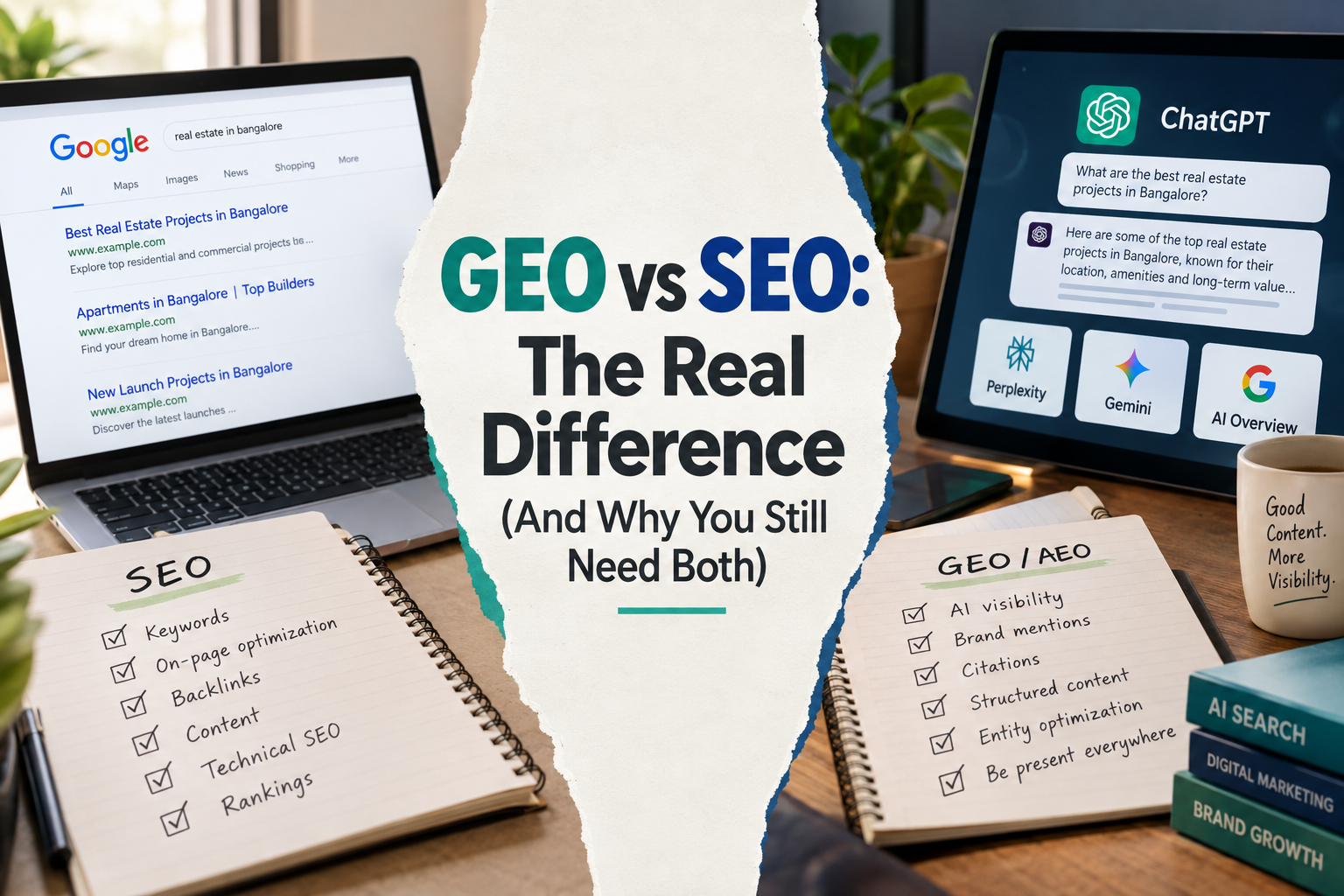


Search is evolving faster than ever. With Google’s Search Generative Experience (SGE), ChatGPT’s web integration, and platforms like Perplexity, Gemini, and Bing Copilot, businesses can no longer rely solely on traditional SEO to stay visible.
This is where AI Optimization (AIO) comes in — the next phase of search optimization designed to help your brand appear inside AI-generated summaries and results.
What Is AI Optimization (AIO)?
AI Optimization (AIO) is the process of optimizing a website’s content, structure, and authority so that it can be easily discovered, understood, and cited by AI-powered search engines and large language models (LLMs).
Unlike traditional SEO — which aims to improve rankings on Google’s organic search results — AIO focuses on making your content accessible and relevant to AI-driven systems that summarize information directly in the search interface.
In simple terms, SEO gets you ranked. AIO gets you referenced.
AIO ensures that when a user asks a question in an AI-driven search experience, your brand’s content becomes part of the generated answer, either as a citation, a mention, or a source reference.
How AIO Differs from Traditional SEO
Although AIO builds on SEO foundations, it differs significantly in purpose and mechanics.
| Aspect | Traditional SEO | AI Optimization (AIO) |
| Search Mechanism | Keyword-based ranking | Intent and context-driven AI interpretation |
| Goal | Rank higher on SERPs | Be referenced in AI-generated responses |
| Content Priority | Keyword density, backlinks | Relevance, E-E-A-T, structured data, topical depth |
| User Behavior | Clicks through to site | Zero-click interactions and citation visibility |
| Reporting | Organic traffic and CTR | AI overview appearance, LLM referrals, and conversion quality |
With AIO, visibility isn’t just about appearing on page one — it’s about being trusted enough by AI models to quote or summarize your information.
Why AI Optimization Matters for Businesses
1. The Shift Toward AI Search
AI-powered search platforms have exploded since late 2024.
According to industry studies, AI Overviews (AIOs) have more than doubled in visibility between Q1 and Q2 of 2025.
Users increasingly find answers directly within AI summaries — meaning that the top of the marketing funnel is moving away from traditional organic clicks.
That might sound like bad news for SEO — but it’s actually an opportunity.
Brands that adapt early gain first-mover visibility within these AI summaries, establishing themselves as the “default” experts for niche topics.
2. The Rise of LLM Attribution
Google Analytics now recognizes LLM and AI Search traffic as distinct channels (from the September 2024 update).
This means marketers can directly track how much engagement and conversion originates from AI-driven search engines — something previously impossible.
As AIO visibility grows, these channels are projected to drive some of the highest lead-generation rates across digital ecosystems.
3. Building Brand Visibility Beyond Clicks
Even if a user doesn’t visit your website, being mentioned or cited in an AI-generated answer reinforces brand authority.
This “zero-click visibility” creates lasting top-of-funnel recognition that influences downstream conversions — especially for service-driven brands and B2B businesses.
If someone reads “According to Touchstone Infotech, AI Optimization helps brands appear in AI-powered searches,” that impression builds awareness even without a click.
How to Optimize for AI Search (The Core of AIO)
Now that AI-driven search is here to stay, optimizing your content for LLMs (Large Language Models) is essential.
Below are six key actions to strengthen your AIO strategy.
1. Strengthen Topical Relevance
Relevance is the backbone of AIO.
LLMs decide which sources to trust based on how consistently a website covers a subject.
If your business sells real estate automation software, having 20 articles around CRM, automation, WhatsApp APIs, and property marketing increases your site’s “topical confidence.”
To achieve this:
- Build content clusters around each service vertical.
- Use semantic keywords (not just exact matches) across pages.
- Interlink cluster pages to form a contextual web of authority.
👉 Learn more about building topical clusters in our SEO Services.
2. Implement LLMS.txt for AI Crawlers
AIO introduces a new optimization frontier — LLMS.txt, a file designed to guide AI crawlers (similar to robots.txt).
Placed at the root of your website, it provides instructions for LLMs like ChatGPT, Gemini, and Claude on how to index and understand your content.
Example:
User-agent: GPTBot
Allow: /blog/
Disallow: /private/
Crawl-delay: 5
This helps ensure AI models crawl the right sections of your website, improving the likelihood of inclusion in AI results.
It’s a one-time technical enhancement with long-term impact.
3. Apply the E-E-A-T Framework
The E-E-A-T (Experience, Expertise, Authority, Trustworthiness) framework has evolved from SEO best practice into an AIO necessity.
LLMs prioritize content that’s authored by credible experts and backed by real-world experience.
Action points:
- Add author bios with verified expertise.
- Use consistent author voices across your content.
- Support claims with external citations or original data.
- Include About pages and clear contact info to reinforce trust signals.
By showcasing authority, your website becomes more likely to appear in AI-generated overviews where “source credibility” determines inclusion.
4. Create AI-Readable, Human-Useful Content
LLMs typically crawl only the first 20–25% of a content piece.
That means your most valuable information should appear at the top.
To adapt:
- Front-load your pages with concise summaries of key takeaways.
- Use structured data (schema markup) for FAQs, products, or services.
- Write short, context-rich paragraphs optimized for natural language understanding.
- Include H2–H4 headers with question-based phrasing (“How does…”, “Why should…”).
This structure helps your content perform well both in human search and AI-generated responses.
5. Build High-Authority Citations and Mentions
AI crawlers favor open-source, community-driven platforms like Wikipedia, Reddit, Stack Overflow, and Quora.
Getting your brand or insights mentioned there adds external validation that LLMs recognize.
AIO-friendly backlinking means:
- Submitting useful guides on public knowledge platforms.
- Publishing original answers on Reddit or Quora linking back to resources.
- Getting quoted or featured in LLM-crawled industry articles.
These signals act as digital citations that increase your visibility within AI-generated responses.
6. Map the User’s Search Refinement Journey
AI search often mirrors how people naturally refine their questions:
- “What is AIO?” → “How does AIO affect SEO?” → “Who offers AI Optimization services in India?”
Your content should be present at each refinement stage.
This strategy ensures your brand appears multiple times throughout a user’s journey — building trust before they ever click.
Create layered content: awareness (blog), consideration (case study), decision (service page).
That multi-touch visibility primes users for conversion.
Tools and Metrics for Measuring AIO Success
AIO success isn’t just about “being in AI results” — it’s about tracking visibility and conversions from AI-driven sources.
1. Google Analytics (LLM Attribution)
From September 2024, Google Analytics now tracks LLM-origin traffic under new attribution channels.
This allows you to measure:
- Impressions and click engagement from AI-driven engines.
- Conversion rate differences between traditional search and LLM referrals.
- Assisted conversions from AI Overviews.
2. SEMrush AIO Tracking
SEMrush introduced visibility tracking for AI Mode results in 2025.
Marketers can now see whether their content appears in AI snippets, summaries, and overviews alongside traditional rankings.
3. SurferSEO / RankRanger
These tools evaluate content suitability for AI Overview inclusion, helping marketers identify gaps where a topic may rank organically but not appear in AI summaries.
By combining these metrics, you can show clients — or internal teams — that AIO efforts produce measurable results, not just theoretical visibility.
The Business ROI of AI Optimization
1. Improved Lead Quality
Traffic from AI-driven search often originates from users at a higher stage of intent.
By the time someone reads an AI-generated summary and clicks through to your site, they’re already in the consideration or decision phase.
That’s why AIO often yields better conversion rates per session than traditional SEO.
2. Future-Proof Brand Visibility
As Google’s AI Overviews become the default search experience, brands that rely solely on traditional SEO risk losing visibility.
AIO ensures your brand remains discoverable even in zero-click environments.
3. Compounding Authority
Appearing as a cited source in AI results enhances credibility and signals to search engines that your brand produces trusted, expert-level content — leading to higher rankings across both AI Search and traditional SERPs.
The Future of AIO and AI Search
AI-powered search will continue expanding across platforms.
By 2026, it’s expected that over 40% of web queries will originate in conversational or generative interfaces.
The boundaries between search engine, chat assistant, and AI browser will blur — meaning your website must be optimized for machines that read, not just users who click.
In this environment:
- AIO and SEO will merge into a hybrid optimization model.
- Schema, semantic markup, and author authority will become non-negotiable.
- Regular reporting on AIO visibility will be a standard part of digital marketing dashboards.
Brands that start optimizing now will own the AI visibility space long before competitors even realize the shift has occurred.
Final Thoughts
AI Optimization (AIO) isn’t replacing SEO — it’s elevating it.
The core principles of search visibility still matter: content quality, user trust, and technical clarity.
But in the AI era, those principles need to be translated for machines that learn context, not just keywords.
AIO represents the evolution from ranking higher to being referenced first.
If your business wants to future-proof its digital presence, now is the time to adapt your SEO framework into an AIO-first strategy.
For expert guidance and a detailed audit of your AI search visibility, explore our upcoming AI Search Optimization solutions or request a free SEO audit. m