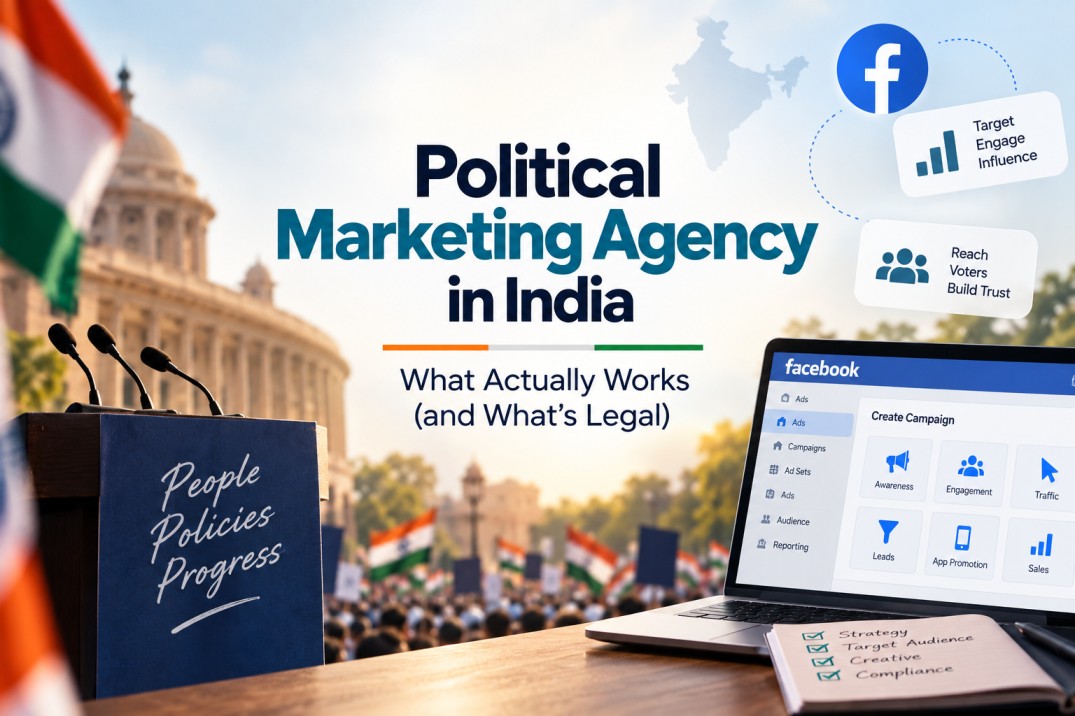

Yes, you can run Facebook ads for political campaigns in India, but you cannot just open Ads Manager and hit publish. Before a single rupee is spent, you need two clearances: Meta must authorize you as a political advertiser, and the Election Commission of India (ECI) requires your ad to be pre-certified by the Media Certification and Monitoring Committee (MCMC). Skip either one and your ad gets rejected, your account gets flagged, and in election season you risk an MCC complaint.
This guide walks you through the whole process the way we run it for candidates and party teams: get authorized, get certified, then build a campaign that actually reaches voters. It is written for India, so the rules, the rupee budgets, and the targeting realities all match what you will face on the ground.
Can you run political ads on Facebook in India?
You can, and thousands of candidates and parties do every election cycle. But Facebook treats anything about elections, candidates, parties, or “social issues of national importance” as a special category with extra rules. Meta calls these SIEP ads (Social Issues, Elections or Politics).
Two gates stand between you and a live ad:
- Meta authorization — you prove who you are and add a “Paid for by” disclaimer to every ad.
- ECI pre-certification — the MCMC approves your ad content before it runs on any electronic or social media platform.
Both take time to clear. If you are planning for a poll date, start at least two to three weeks early. From what we see with clients, the single biggest reason a campaign loses precious days is treating authorization as a last-minute formality. It is not. Do it first.
Step 1 — Get Meta authorization to run political ads
Meta will not let you run a single political ad in India until your identity is confirmed and a disclaimer is live. Here is the exact sequence.
- Confirm your identity. Go to Meta’s identity confirmation page and upload a government-issued ID (Aadhaar, PAN, passport, voter ID, or driving licence). The name on the ID must match your Facebook profile name.
- Turn on two-factor authentication. Meta requires it for political advertisers. Use SMS or an authenticator app in your account security settings.
- Create your ad disclaimer. In your ad account settings, open the disclaimer section and enter who is paying for the ads: the candidate, the party, or the registered organisation, with contact details. This is the “Paid for by” line voters will see on your ad.
- Submit supporting documents. Meta may ask for proof of address or registration documents to verify the disclaimer. Have them ready as clear scans.
- Link the disclaimer to your ad account and submit for authorization. Once approved, your account can run ads that carry that disclaimer.
How long it takes: identity confirmation is usually a day or two; disclaimer and account authorization can take several days. Plan for a week end to end, and longer if Meta asks for more documents.
Trust note: Every political ad you run in India is stored in the Meta Ad Library for seven years, with your spend and the “Paid for by” label visible to anyone. Assume your opponent, journalists, and fact-checkers are watching. That is a reason to keep messaging clean, not a reason to avoid ads.
You can read Meta’s own rules on the Meta Business Help Center. They update these periodically, so check before every major campaign.
Step 2 — Get ECI/MCMC pre-certification (the step global guides skip)
This is the step every US or UK guide leaves out, and the one that gets Indian campaigns into real trouble. In October 2025 the Election Commission of India reaffirmed that all political advertisements, including those on social media and internet platforms, must be pre-certified by the MCMC before they go live. This is not optional and it is separate from Meta’s approval.
Here is how pre-certification works:
- The MCMC operates at both state and district level. You apply to the committee for the area where you are advertising.
- You submit the ad script, the audio-video file or creative, and a self-signed declaration on the prescribed form.
- Apply ahead of your planned publish date, not on the day. Committees need lead time to review.
- Candidates must also declare their authentic social media handles when filing nomination papers, and account for ad spend in their election expenditure statement, which is due within 75 days of the poll.
Facebook itself checks for this. For political ads in India, Meta verifies the advertiser and expects compliance with local law, and shares expenditure details with the ECI. So the two systems are linked: Meta authorization gets you technical access, MCMC certification keeps you legal.
A common mistake: teams get Meta approval, feel cleared, and forget the MCMC step entirely. Then a rival files a complaint through the ECI cVIGIL app and the ad comes down mid-campaign. Do both, keep the paperwork, and you avoid the whole problem.
Section 126 and the 48-hour silence period
Under Section 126 of the Representation of the People Act, 1951, no election matter may be displayed in a polling area during the 48 hours ending with the close of poll. The ECI has reaffirmed for 2026 that this applies to social media, not just TV and print.
In plain terms: stop all political ads at least 48 hours before polling ends in that constituency. Because Indian elections run in phases, the silence period is different for each phase and each seat. If you are running ads across multiple constituencies, you have to pause them seat by seat as each phase approaches.
Build this into your ad scheduling from day one. Set end dates in Ads Manager that respect the silence window for every location you target. Getting this wrong is not just an ad rejection, it is a legal violation that opponents actively report.
Setting up your campaign in Ads Manager
Authorized and certified? Now you build the campaign. Open Meta Ads Manager and hit Create. You will set three things: the campaign (your goal), the ad set (your targeting and budget), and the ad (your creative).
Choosing the right objective
Match the objective to the stage of your campaign:
- Awareness — early on, when you need name recognition across a constituency.
- Traffic — to send voters to your website, manifesto page, or a WhatsApp link.
- Engagement — to boost a strong post, grow your page, or collect video views on a speech or rally clip.
- Leads — to collect volunteer sign-ups or supporter details through an instant form.
For a first campaign, awareness or traffic is the safest start. Do not chase every objective at once.
Voter targeting in India: what works and what does not
Targeting is where campaigns win or waste money. Your strongest lever in India is geography: you can target down to a city, a pin code radius, or a set of assembly segments. Layer on:
- Age and gender, if your message is aimed at first-time voters, women voters, or senior citizens.
- Language, which matters hugely in India. A Bhojpuri or Marathi creative served to the right language audience outperforms a generic Hindi or English one.
- Interests, used carefully. Meta has narrowed sensitive interest categories, so do not rely on caste, religion, or explicit political-leaning targeting. It is restricted, and frankly it invites complaints.
Honest caveat: Meta has deliberately limited how finely you can target voters by sensitive attributes. Do not build your plan around targeting people by community. Build it around location, language, and behaviour instead. It is more compliant and it usually works better.
Custom and lookalike audiences
These are the audiences serious campaigns run on:
- Custom audience from your data — upload your volunteer or supporter list (phone numbers, emails) and Meta matches them to profiles. Only use data you are legally allowed to use.
- Website visitors — install the Meta Pixel on your campaign site and retarget everyone who visits.
- Engagers — people who watched your video, opened a lead form, or interacted with your page. This is a warm audience and often your cheapest to convert.
- Lookalike audience — once you have a custom audience, Meta builds a larger group of similar users in your target state. This is how you scale reach without losing relevance.
Budgets and what results to expect
There is no single “correct” budget, but here is a realistic planning frame for an Indian campaign. Treat these as starting points, not promises: costs rise sharply near polling day as every candidate bids at once.
| Stage | Suggested daily budget (INR) | What it is for |
|---|---|---|
| Testing | ₹500 to ₹1,500 per ad set | Find which message and creative works before you scale |
| Awareness push | ₹2,000 to ₹10,000+ | Reach across a constituency once you know what performs |
| Retargeting | ₹300 to ₹1,000 | Stay in front of warm audiences cheaply |
Metrics to watch, checked at least weekly:
- CTR (click-through rate) — aim for above 1%. Below that, your creative or targeting is off.
- CPM (cost per 1,000 impressions) — expect it to climb steeply in the final fortnight before a poll. Budget for that spike.
- Cost per result — cost per landing page view, per lead, or per video view depending on your objective.
- Frequency — if the same voters see your ad too many times, results drop. Refresh the creative.
Ad creative that works for Indian voters
Strong political creative in India is simple, fast, and local. A few things that consistently perform:
- One message per ad. A single promise or issue beats a list of ten.
- Vernacular language. Speak the voter’s language, literally. Regional-language video outperforms polished English.
- Short video. A 15 to 30 second clip from a rally, a walk-through of a completed project, or a direct-to-camera message tends to beat static images.
- A clear next step. “Join on WhatsApp,” “Watch the full speech,” “See our work.” Give voters one action.
- Distil the headline. Three or four words that stick, backed by one line of context.
Integrating WhatsApp and Instagram
Facebook ads are one channel, not the whole plan. The campaigns that convert connect the ad to where Indian voters already are:
- Click-to-WhatsApp ads let a voter tap your ad and start a chat instantly. This is powerful in India for volunteer recruitment and local queries. Route it into a proper chatbot or team so nobody is left waiting.
- Instagram placements reach younger and urban voters. Run the same authorized campaign across both Facebook and Instagram from one ad set.
- Messenger and Reels extend reach further if your creative suits short vertical video.
Common mistakes we see in political campaigns
From running these campaigns, the same avoidable errors come up again and again:
- Starting authorization too late and losing a week of campaign time waiting for Meta and MCMC clearance.
- Forgetting the MCMC step after getting Meta approval, then getting the ad pulled on a complaint.
- Ignoring the 48-hour silence period, especially across phased polling in multiple seats.
- Boosting posts randomly instead of building structured campaigns with proper objectives and audiences.
- Running one ad to everyone instead of testing messages by language and location.
- No tracking, so there is no way to know what worked and repeat it.
Fix these six and you are already ahead of most campaigns spending far more than you.
Running a political campaign is high-pressure and the compliance layer is unforgiving. If you would rather have an experienced team handle Meta authorization, MCMC certification, and the day-to-day campaign so you can focus on the ground game, that is exactly what our political digital marketing team does for candidates and parties across India. It is a helpful next step if compliance and ad management are pulling you away from voters.
Quick reference table
| Requirement | What you must do | Who enforces it |
|---|---|---|
| Advertiser authorization | Confirm ID, enable 2FA, add “Paid for by” disclaimer | Meta |
| Ad pre-certification | Submit creative and script to MCMC before publishing | ECI / MCMC |
| Silence period | Stop all ads 48 hours before poll closes in that seat | ECI (Section 126, RPA 1951) |
| Transparency | Ad stays in Meta Ad Library for 7 years with spend visible | Meta |
| Expenditure reporting | Account for ad spend in election expenditure statement | ECI |
| Handle declaration | Declare authentic social media accounts at nomination | ECI |
Frequently asked questions
Do I need permission to run political ads on Facebook in India?
Yes. You need Meta’s advertiser authorization (ID confirmation plus a “Paid for by” disclaimer) and ECI pre-certification of the ad content from the MCMC. Both are mandatory before the ad runs.
How long does Facebook political ad authorization take in India?
Identity confirmation is usually one to two days. The disclaimer and ad-account authorization can take several days, longer if Meta requests extra documents. Plan for about a week end to end.
What is MCMC pre-certification and is it compulsory?
The Media Certification and Monitoring Committee, set up by the ECI at state and district level, reviews and approves political ad content before it goes live. Since October 2025 it is compulsory for all political ads on social media in India.
Can I run political ads during the 48-hour silence period?
No. Section 126 of the Representation of the People Act, 1951 bars election matter in a polling area during the 48 hours before the poll closes, and the ECI applies this to social media. Schedule your ads to stop before that window in each constituency.
How much should a political campaign budget for Facebook ads?
Start small to test, around ₹500 to ₹1,500 per day per ad set, then scale the winners. Awareness pushes often run ₹2,000 to ₹10,000+ per day. Expect costs to rise sharply in the final two weeks before polling.
Can I target voters by caste or religion on Facebook?
No, and you should not try. Meta restricts targeting by sensitive attributes, and it invites complaints. Target by location, language, age, and behaviour instead, which is both compliant and more effective.
Are my political ads visible to the public?
Yes. Every political ad in India is stored in the Meta Ad Library for seven years, showing who paid for it and how much was spent. Assume opponents and journalists can see your full ad history.
Can I run the same ad on Instagram and WhatsApp?
You can run one authorized campaign across Facebook and Instagram from a single ad set. WhatsApp connects through click-to-WhatsApp ads, which let a voter start a chat directly from your ad.