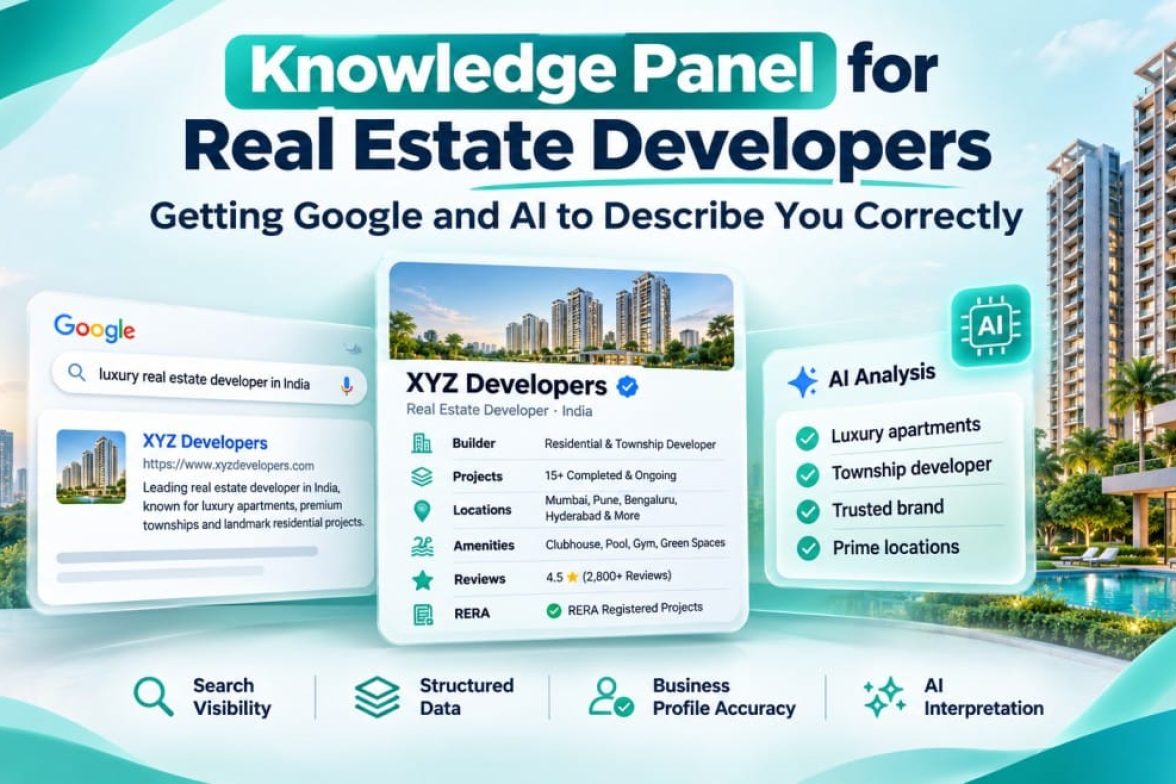

Search your company’s name on Google and look at the right side of the results. You might see a panel with your logo, founding year, headquarters and leadership. You might see a site office’s Business Profile, a channel partner’s listing, or nothing at all. Now ask ChatGPT or Gemini the same question. The answer may merge two of your projects, name a former director, or quote a possession date your RERA filing doesn’t support.
A knowledge panel for a real estate developer is the visible end of a longer chain: the facts that Google and AI systems hold about your company, its promoters and its projects. This guide covers where those facts come from, what a developer can actually control, and who inside the organisation should own the work.
Quick answer
Google generates knowledge panels automatically from sources across the web, so a developer can’t apply for one. What a developer can do is give Google and AI tools consistent, referenced facts about the company, its promoters and its projects: one entity home page, Organization schema, Wikidata items and independent coverage. Paid press releases don’t build the notability that panels depend on.
Why a knowledge panel for a real estate developer is harder to get right
An agent or broker is one person with one name. A developer is a family of entities:
- The group or brand. Often a listed parent, several SPVs, and a trading name buyers know better than the legal name.
- Promoters and leadership. Their names appear on RERA filings, annual reports and news coverage.
- Projects. Each has its own name, location, RERA registration number, phases and possession timeline.
Search systems have to work out which facts belong to which entity. When project names echo the brand, an SPV shares an address with the parent, or two projects in different cities carry similar names, the facts blur. That is how a buyer ends up reading the wrong possession date in an AI answer, and it shapes what buyers and AI see before they call.
The fix starts with the data, not the panel.
Where Google and AI tools get facts about your company
Google says knowledge panels are generated automatically and that their information comes from various sources across the web. It doesn’t publish a fixed list. For an Indian developer, these are the sources that usually matter:
| Source | What it shapes | Who controls it |
|---|---|---|
| Official website (About, leadership, project pages) | The facts you state about yourself | You |
| Organization structured data on that site | How Google reads your name, logo and linked profiles | You |
| Wikidata | Machine-readable facts with references | Open community; you can contribute |
| State RERA portals, MCA records, exchange filings | Registration numbers, directors, legal names | Regulators; you keep filings current |
| Independent news and trade coverage | Corroboration and context | Journalists |
| Property portals and review sites | Project facts and sentiment | Partly you, mostly others |
| Google Business Profiles for site and sales offices | Local panels, Maps, reviews | You |
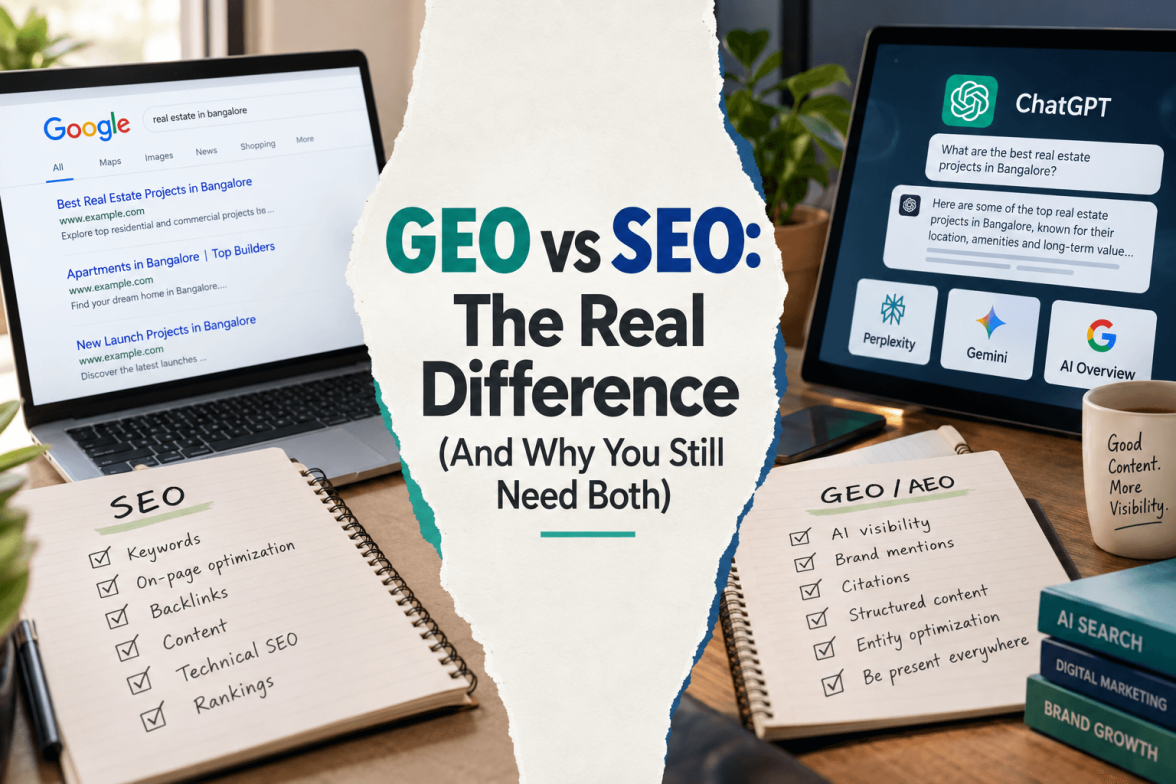
AI assistants read similar public material, so the same clean, consistent entity data serves the panel, AI Overviews and the answers other assistants give. Our GEO vs SEO guide covers where the two overlap.
What Google says: there are no additional requirements to appear in AI Overviews or AI Mode beyond standard SEO best practice (Google Search Central). Accurate, consistent entity data is part of that practice, not a separate trick.
Knowledge panel vs Google Business Profile: which one are you seeing?
Many developers believe they have a knowledge panel when they’re looking at a Google Business Profile for a sales gallery or corporate office. Google treats these as different things. Business Profiles are for businesses that serve customers at a particular location, and Google notes that the two only look similar.
Both matter. A Business Profile helps the buyer who wants directions to the site office, and developers with several sites need a plan for managing multiple Business Profiles. The entity panel describes the company itself: what it is, when it was founded and who leads it. If a brand search shows an office profile in place of a company panel, Google hasn’t yet formed a confident picture of the organisation.
How to build the entity layer, step by step
STEP 1
Entity home
One page, one set of facts
STEP 2
Organization schema
Name, logo, sameAs
STEP 3
Wikidata items
Group, promoters, projects
STEP 4
Independent coverage
Earned, not paid
STEP 5
Claim and maintain
Verify, then fix upstream
1. Make one page your entity home
Pick one page, usually About, that states the core facts plainly: legal name, brand name, year founded, headquarters city, promoters and leadership, listing details if any, and the project list with locations and RERA numbers. Then use exactly the same names everywhere else, including LinkedIn, annual reports, portal listings and press kits. Small differences (“Pvt Ltd” vs “Private Limited”, a group name with and without “Group”) give systems a reason to doubt they’re looking at one entity.
2. Add Organization schema with sameAs
Google says Organization structured data helps it understand an organisation’s administrative details and tell it apart from others, and that the logo you specify can affect what appears in the knowledge panel. Place it on the homepage or About page. Use sameAs to point to profiles that describe the same company. A trimmed example:
{
  "@context": "https://schema.org",
  "@type": "Organization",
  "name": "Example Developers",
  "legalName": "Example Developers Private Limited",
  "alternateName": "Example Group",
  "url": "https://www.exampledevelopers.in/",
  "logo": "https://www.exampledevelopers.in/images/logo.png",
  "foundingDate": "2004",
  "founder": { "@type": "Person", "name": "Founder Name" },
  "address": {
    "@type": "PostalAddress",
    "addressLocality": "Gurugram",
    "addressRegion": "Haryana",
    "addressCountry": "IN"
  },
  "sameAs": [
    "https://www.wikidata.org/wiki/Q00000000",
    "https://www.linkedin.com/company/example-developers",
    "https://www.youtube.com/@exampledevelopers"
  ]
}
Two cautions. List only profiles that genuinely describe this entity. And keep the markup identical to what the page says in plain text.
3. Create Wikidata items for the group, promoters and flagship projects
Wikidata accepts an item that describes a clearly identifiable entity supported by serious, publicly available references, and its editing help asks contributors not to create items for promotional purposes. For a developer, that usually means three kinds of item, with a reference on every claim:
| Item | Core properties | Typical references |
|---|---|---|
| Company | instance of (P31), official name (P1448), inception (P571), founded by (P112), chief executive officer (P169), headquarters location (P159), industry (P452), official website (P856), stock exchange (P414) and ticker symbol (P249) if listed, parent organization (P749) or subsidiary (P355) | MCA records, exchange filings, annual reports, independent news |
| Promoter or leader | instance of human (P31: Q5), employer (P108), occupation (P106) | Annual reports, exchange disclosures, news coverage |
| Flagship project | instance of (P31), located in the administrative territorial entity (P131), coordinate location (P625), date of official opening (P1619) | State RERA portal, independent news |
Attach a reference URL (P854) to each statement. Search before creating anything, since duplicate items are common for companies with similar names. Not every project needs an item: start with those that have independent coverage.
For one Gurugram-based developer, Touchstone built Wikidata items for the group, its leadership and its projects, then linked them to each other and to the website’s schema. The linking is the point. Each item confirms the others.
4. Earn independent coverage (paid press releases won’t do it)
This is the step most developers try to shortcut. Panels follow notability: Google needs enough independent, reliable information to be confident about an entity, and Wikipedia and Wikidata apply a similar test. Announcements, paid press releases and sponsored features are the company describing itself, so they add little or nothing. Wikipedia’s guidance for publicists is explicit that press releases and notices don’t count as reliable sources for companies, and neither do interviews where the subject says whatever they please.
One rule overrides the rest
Notability can’t be bought. Ten wire releases about a launch add less than one story a business journalist chose to write.
What does count is reporting that journalists do on their own editorial terms: launches, deliveries, results, regulatory developments and leadership changes. RERA records and exchange filings help corroborate facts, but they don’t establish notability on their own.
For corporate comms, that changes the brief. Issue fewer wire releases, and pitch more stories reporters would cover anyway: a delivery milestone, audited results, a promoter’s view on a policy change.
5. Claim and maintain the panel
Once a panel appears, look for “Claim this knowledge panel” at the bottom. Google notes that not every panel can be claimed yet and suggests checking back periodically. After verification, you suggest changes through the Feedback option. These are suggestions, not overrides, so a wrong fact on the panel usually means a wrong or conflicting fact upstream. Fix the source too.
Do you need a Wikipedia page?
It helps if your company genuinely qualifies, but it isn’t where to start. Wikipedia expects significant coverage in reliable, independent sources and has strict rules on people editing articles about their own employers. Build the entity home, schema, Wikidata items and independent coverage first. If an article later becomes justified, an independent editor can write it from that coverage.
Who should own this: CMO, corporate comms or agency?
| Task | Usual owner | Notes |
|---|---|---|
| Master fact sheet (legal names, SPVs, leadership, projects, RERA numbers) | Corporate comms with the company secretary | One source of truth, reviewed quarterly |
| Entity home and Organization schema | Marketing or web team, or agency | Update when leadership or projects change |
| Wikidata items | Comms, supported by an experienced editor | Neutral wording, references on every claim |
| Earned coverage | PR and corporate comms | Measured in independent stories, not releases issued |
| Panel claim and feedback | CMO’s office | Keep verified access with the company, not one person |
| AI answer checks | Marketing or agency | Quarterly, across ChatGPT, Gemini and AI Overviews |
The CMO usually sponsors the work and corporate comms owns the facts. Problems start when nobody owns the fact sheet and five teams publish five versions of it.
What to measure
Google doesn’t promise a timeline, and anyone guaranteeing a panel by a fixed date is guessing. Track these instead:
- Whether a company panel, not an office profile, appears for your brand name and its common variants
- Whether every fact in the panel matches your fact sheet
- How ChatGPT, Gemini and AI Overviews describe the company, its promoters and top projects (our 30-minute AI visibility audit for developers gives a simple scoring method)
- How many independent articles about the company are published each quarter
What this means
A knowledge panel is a reading of how well search systems understand your company. For a developer, the hard part is keeping the group, its promoters and its projects distinct and consistent across every source. Treat the master fact sheet as the asset and the panel as the gauge. When the facts are clean and independently reported, accurate panels and accurate AI answers tend to follow.
Key takeaways
- Google generates knowledge panels automatically. No developer can request or buy one.
- A developer is several entities at once (group, SPVs, promoters, projects), and most wrong AI answers come from those entities blurring together.
- Organization schema on the homepage or About page helps Google tell your company apart from others and choose the logo it shows.
- Wikidata items need serious, public references. Items created for promotion get deleted.
- Paid press releases and announcements don’t build notability. Independent coverage does.
- Corporate comms should own one master fact sheet that every channel copies from.
Frequently asked questions
Can a real estate developer get a knowledge panel without a Wikipedia page?
Yes. Google builds knowledge panels from various sources across the web, and Wikipedia is only one of them. Most developers should start with a clear entity home page, Organization schema, referenced Wikidata items and independent news coverage. A Wikipedia article only makes sense once enough independent coverage exists to support it.
How do we claim our company’s knowledge panel?
Search for the company, find its knowledge panel and click “Claim this knowledge panel” at the bottom. Google then asks you to verify through an official profile or site, such as YouTube or Search Console. Not every panel can be claimed yet, so check back periodically. Once verified, you suggest edits through the Feedback option.
Why does Google show our site office instead of a company knowledge panel?
A site or sales office with a Google Business Profile can produce a local panel, which is different from the company’s entity panel. If the office profile appears in its place, Google has stronger signals for that location than for the organisation itself. Work on the entity home, Organization schema, Wikidata and independent coverage.
Do paid press releases help get a knowledge panel?
Not in any meaningful way. Knowledge panels depend on notability, meaning enough independent, reliable information about the company. Press releases, announcements and sponsored articles are the company talking about itself. Wikipedia’s guidelines for companies exclude them as evidence of notability, and the same logic applies to the corroboration Google looks for.
Should every real estate project have its own Wikidata item?
No. Create items only for projects that are clearly identifiable and described by serious public references, such as flagship or delivered projects with independent news coverage. Reference the state RERA portal for registration facts, and check that the item does not already exist before creating it.
Why does ChatGPT describe our company incorrectly?
AI assistants draw on public sources. When those sources disagree on legal names, leadership or project facts, or when similarly named companies and projects exist, answers blur them together. Fix the facts at source, keep them identical across your website, profiles and filings, and recheck AI answers every quarter.
Find out how Google and AI describe your company
If your brand search shows a site office instead of a company panel, or AI tools mix up your projects and promoters, book an AI visibility (GEO) consultation with Touchstone’s real estate marketing team. We’ll review your panel, entity data and AI answers with you and set out what to fix first.