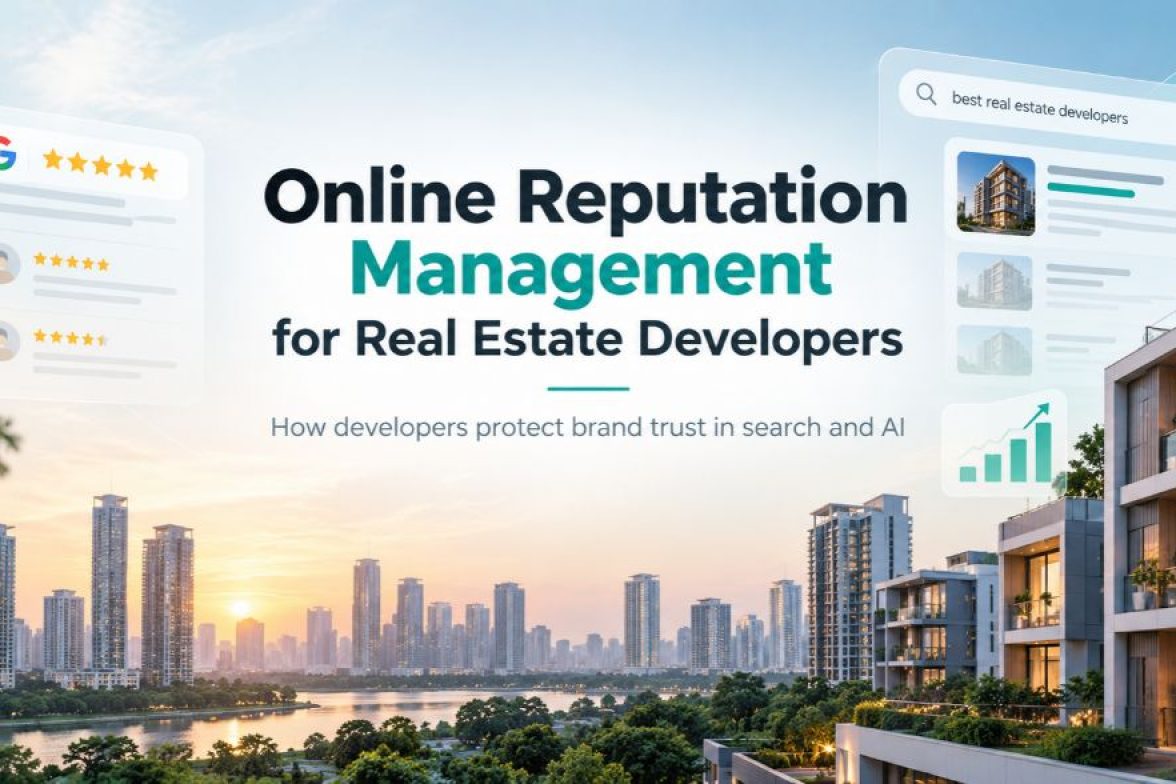

Online reputation management for real estate developers is the work of managing and improving what buyers discover when they look you up: your search results, your project reviews, your RERA record, the forum threads, and now the answer an AI assistant gives when someone asks whether you are a reliable builder. Most premium developers manage one or two of these well. Very few have anyone watching all five, and almost nobody is checking what ChatGPT says about them.
That gap matters because premium buyers research the developer long before the first site visit. By the time your sales team gets the call, the buyer has usually formed a view, and your marketing team had no say in most of what shaped it.
Online reputation management (ORM) for real estate developers means monitoring and improving five things buyers check before they enquire: brand and project search results, Google reviews on project profiles, RERA and news records, community content such as YouTube and forums, and AI-generated answers from ChatGPT, Gemini, Perplexity and Google AI Overviews. The work combines review response, accurate published project facts, structured entity data and earned coverage.
What online reputation management for real estate developers covers
For a developer, ORM is not damage control after a bad article. It is the ongoing job of making sure every public source a buyer checks says something accurate, current and fair about your brand, your leadership and each project.
Online reputation management for real estate developers: the continuous monitoring and improvement of a developer’s search results, reviews, regulatory records, community content and AI-generated descriptions, so that buyers, channel partners and lenders find accurate information about the brand and its projects.
Two things make developer ORM harder than ORM for a restaurant or a clinic. First, a developer has many profiles to look after: the corporate brand, every project, every site office, and often the promoters by name. Second, the purchase is rare and expensive, so buyers look harder. One delayed possession from 2019 can still sit on page one of Google for your brand name today.
Brand is also carrying more of the sale than it used to. In a July 2026 exchange4media report on luxury housing, Rajat Khandelwal, Group CEO of Tribeca Developers, said brand equity “has evolved from being a differentiator to becoming one of the strongest drivers of premium home purchases.” Smita Khanna Kithania of Newton Consulting India put it more simply: “a project may sell once, but a trusted brand can sell for decades.” (exchange4media)
The five places buyers judge a developer before the first call
Buyers check five places, and in most developer organisations each one has a different owner or no owner at all.
| Where | What the buyer sees | Who usually owns it |
|---|---|---|
| Brand and project-name search results | Your site, portal listings, news, complaint pages, broker pages using your project name | Digital marketing, partly |
| Google reviews on project and site-office profiles | Star rating, recent reviews, whether you reply | Often nobody, sometimes the site office |
| RERA records and news coverage | Registration details, quarterly updates, complaints, press | Legal and corporate communications |
| YouTube walkthroughs, forums and WhatsApp groups | Construction videos, resident discussions, possession stories | Nobody |
| AI answers (ChatGPT, Gemini, Perplexity, AI Overviews) | A summary of who you are, whether you are reliable, and how you compare | Nobody |
Brand and project-name search results
Search your brand name, then your brand name plus “reviews”, “complaints” and “possession”. Then search each live project by name. Count how many of the top 10 results you control or would be happy for a buyer to read. For many developers, portals and channel partner pages outrank the project’s own page for its own name, which means someone else is framing your launch.
Google reviews on project and site-office profiles
Buyers read project reviews the way they read hotel reviews: they look at the pattern and at how the developer replies. An unanswered complaint from a resident about a leaking basement does more harm than the complaint itself, because the silence tells the buyer how you will treat them after handover.
Not every office automatically qualifies for its own listing. Google’s Business Profile guidelines exclude locations a business does not actually operate from, and expect a location to receive customers during its stated hours. A staffed sales office or site office that meets those rules may qualify, so check eligibility before creating one. For every profile you do hold, name one person responsible for replies. We covered how this works across several locations in our case study on managing multiple Google Business Profiles for a real estate developer.
RERA records and news coverage
Under Section 11(1) of the Real Estate (Regulation and Development) Act, 2016, a promoter creates a web page for each registered project on the state authority’s website and keeps it updated, with state regulations setting quarterly progress reports (see, for example, Haryana RERA Gurugram’s Quarterly Progress Report Regulations, 2018). Serious buyers and their lawyers check it. If your RERA page shows overdue quarterly updates, no amount of marketing copy will fix the impression. News coverage works the same way: an old story about a dispute stays in search results until newer, stronger coverage displaces it.
YouTube walkthroughs, forums and WhatsApp groups
Independent walkthrough channels, resident forums and buyer WhatsApp groups are where buyers go for the version you did not write. You cannot control them, but you can supply accurate material: construction progress videos, possession timelines and a named customer care contact who replies.
AI answers from ChatGPT, Gemini, Perplexity and AI Overviews
This is the newest place and the least watched. Buyers can now ask an assistant to compare developers, summarise a builder’s track record or suggest new launches in a micro-market. In August 2026, Chennai developer Casagrand appointed AdLift to deploy its AI search visibility platform, Tesseract, to strengthen the brand’s presence across the language models buyers use for research. The report noted that homebuyers are “asking ChatGPT, Gemini, Google AI Overviews and Perplexity to compare developers” (Indian Television). The difference from a Google results page is that the buyer reads one summarised answer instead of scanning ten links. If that answer leaves you out, or repeats an outdated complaint, you may not get the chance to correct it.
Why AI assistants can get developers wrong
Each AI assistant uses its own retrieval and ranking methods, and none publishes exactly which sources it relies on. Still, inaccurate descriptions of developers tend to trace back to three conditions, and each can be improved.
- Thin entity data. If there is no clear, structured record of who the company is, who leads it, when it was founded and which projects it has delivered, an answer may be assembled from whatever else is available, including broker pages and old forum posts.
- Stale project facts. Possession dates, approvals and configurations change. If the most detailed pages about a project are portal listings from launch, answers may repeat launch-era information.
- One loud story. When a developer has little coverage overall, a single dispute or delay becomes a large share of everything written about it, which raises the chance it appears in a summary.
None of this needs a new website. Structured, consistent and authoritative information about your company and projects improves the chances that search engines and AI assistants represent you accurately. It does not guarantee a particular answer.
Example: building AI visibility for an Indian developer
A leading Indian real estate developer
The developer wanted to strengthen its digital authority and expand visibility across traditional and AI-powered search platforms, despite having a relatively limited number of website pages.
Touchstone ran four workstreams together: AI search optimisation aimed at ChatGPT, Google AI Overviews and Gemini; entity authority through Wikidata, structured entity information and consistent citations for the brand, leadership and projects; SEO and content placements for non-branded property searches; and brand consistency across local search profiles.
Client-reported results from Semrush’s AI toolkit and Semrush organic traffic estimates, from the latest project reporting. Estimates are not measured site traffic.
The lesson for other premium developers is the order of work. A small website did not stop this developer from gaining AI visibility. The work focused on a clean, consistent record of who the developer is and what it has built, which improved its chances of being represented in AI answers.
How to audit your developer brand in 60 minutes
A useful audit takes about an hour and needs no tools beyond the AI assistants themselves and a spreadsheet. Run each prompt below in ChatGPT, Gemini and Perplexity, and run the search versions in Google to see whether an AI Overview appears.
- Who is [developer name]?
- Is [developer name] a reliable builder?
- What do buyers say about [developer name]? Any complaints?
- Has [developer name] delivered its projects on time?
- Who founded [developer name] and who leads it today?
- Tell me about [project name]. Is it RERA registered?
- Compare [developer name] and [main competitor].
- Best luxury developers in [city].
- Best new launches in [micro-market] under [budget].
- Should I buy in [project name]? What are the risks?
Score every answer using four labels, and note which sources the assistant cites.
| Score | What it means | Typical fix |
|---|---|---|
| Accurate | Correct, current, and names you where it should | Keep the sources it cites up to date |
| Incomplete | Correct but thin, or missing recent projects | Publish detailed project and company fact pages |
| Wrong | Outdated dates, wrong leadership, or an old complaint presented as current | Correct the cited sources and publish newer, stronger ones |
| Absent | You are not mentioned in a shortlist question where you should be | Entity data, editorial coverage and comparison content |
Prompts 8 and 9 matter most for premium developers. These are shortlist questions, and a missing name there costs you buyers who never visit your website at all.
The fix, in order of impact
Work through these in order. The early steps make every later step more effective.
- Entity data. Create or correct structured records for the company, its leadership and its major projects, such as Wikidata entries and Organization schema on your website. If Google already shows a Knowledge Panel for your brand, check whether it can be claimed; Google states that not all knowledge panels are claimable, and it does not create one on request. Make names, founding dates and project lists identical everywhere.
- Project fact pages. Give every live project its own page on your site with RERA number, approvals, configurations, possession timeline and the latest construction update. Update it whenever the RERA page changes. This gives search engines and AI assistants a current, first-party source alongside portal listings.
- A review response system. One owner, a response time target, and a reply structure: acknowledge, state the fact, give a named contact, follow up publicly when resolved. Ask for reviews at booking and again after handover, once snags are closed.
- Earned coverage. Interviews with leadership, project milestones and market commentary in real estate and business publications. Newer, stronger coverage can push an old negative story down the results and gives AI assistants more independent information to draw on.
- A crisis protocol. Decide in advance who responds, where, and within how many hours when a site incident, delay or legal dispute becomes public.
This is the same sequence our AI visibility services follow, and it works alongside the search groundwork in our real estate SEO playbook.
What the rules allow: reviews, incentives and disclosure
Developers can ask buyers for reviews. They cannot pay for them, filter them or pressure people to change them.
- Google: its user-contributed content policy prohibits content “posted due to an incentive offered by a business”, including reviews revised or removed in exchange for an incentive. Google added the revision and removal wording in September 2022 (Search Engine Land).
- Bureau of Indian Standards: IS 19000:2022 sets out how organisations should collect, moderate and publish online consumer reviews. It bars publishing reviews purchased or written by people employed for that purpose, and requires paid reviews to be labelled. It is voluntary for now, with the government stating it may become mandatory (Business Today).
- RERA: keep marketing claims consistent with what is registered for the project. A mismatch between an ad and the RERA page is the kind of detail a careful buyer will notice.
A sudden burst of five-star reviews can also look bought to buyers, even when it is not. Steady reviews tied to real milestones, such as booking and handover, read as more credible.
What to measure every month
Track a short set of numbers monthly and review them with sales, not just marketing.
| Metric | How to measure | What good looks like |
|---|---|---|
| Brand search page-one control | Top 10 results for brand name and each project name | You own or are comfortable with most of page one |
| Rating per project profile | Google Business Profile for each project and site office | Stable or rising, with recent reviews |
| Review response rate and time | Share of reviews answered, median hours to reply | Every review answered, negatives within a working day |
| AI answer accuracy | The 10-prompt audit, scored monthly | Fewer “wrong” and “absent” scores each month |
| AI mentions and citations | An AI visibility tracking tool, such as Semrush’s AI toolkit | Rising mentions, with your own pages among the cited sources |
| Negative mentions on page one | Brand plus “complaints” and “reviews” searches | Falling, or answered publicly |
What this means
A premium developer’s reputation is no longer decided mainly by its brochures, hoardings or PR. It is decided by whatever a buyer reads in search results, project reviews, RERA records, community content and AI answers, and AI answers often draw on the other four. Online reputation management for real estate developers is the work of making those sources accurate, current and consistent, with one team accountable for all five.
Key takeaways
- Buyers judge a developer in five places before they call: search results, project reviews, RERA and news records, community content, and AI answers.
- AI assistants give buyers one summarised answer instead of ten links, so a developer missing from that answer may lose the buyer before any visit.
- Inaccurate AI descriptions of developers often trace back to thin entity data, stale project facts or one dominant negative story. Structured, consistent information improves the chances of accurate representation.
- Developers can ask for reviews but cannot pay for them or incentivise changes to negative ones, under Google policy and BIS IS 19000:2022.
- A 10-prompt monthly audit across ChatGPT, Gemini and Perplexity is the simplest way to see what buyers are being told about your brand.
Frequently asked questions
What is online reputation management for real estate developers?
It is the ongoing work of monitoring and improving what buyers find about a developer online: brand and project search results, Google reviews, RERA and news records, community content, and AI-generated answers. The aim is for every source to be accurate, current and fair.
How do buyers check a builder’s reputation in India?
They search the developer and project names, read Google reviews for each project, check the state RERA portal, watch independent walkthrough videos, ask in buyer groups, and increasingly ask AI assistants to summarise the developer’s track record.
Can a developer ask buyers for Google reviews?
Yes. Developers can ask buyers for an honest review. Under Google’s user-contributed content policy, they cannot offer discounts, gifts or other incentives for reviews, or offer incentives to change or remove a negative one.
Can negative reviews of a real estate project be removed?
Only reviews that break the platform’s policy, such as spam, fake reviews or off-topic content, can be reported for removal. Genuine negative reviews stay. The effective response is a factual public reply, a named contact and a visible follow-up once the issue is resolved.
How does ChatGPT decide what to say about a real estate developer?
Each AI assistant uses its own retrieval and ranking methods, and none publishes a full list of the sources it relies on. Answers generally reflect what is available about the company, such as its own website, structured data, news coverage, portals and review sites. Where that information is thin or outdated, the answer can be too, so publishing accurate, consistent facts improves the chances of an accurate description.
How long does ORM take to show results for a developer?
Review replies and updated project pages are visible as soon as they are published. Changes to entity data and new editorial coverage can take months to show up in search results and AI answers, and timing varies by platform because each updates on its own schedule.
Find out what buyers and AI are told about your brand
We will run the 10-prompt AI audit across ChatGPT, Gemini and Perplexity, review your brand and project search results, and check review coverage for every project profile. You get a scored report and a prioritised fix list for your marketing team.
Book a reputation and AI visibility audit
Prefer to talk it through first? Book a call with our team. See more of our work for developers on our real estate marketing page.