
Quick answer: ChatGPT Ads are sponsored cards that OpenAI shows below ChatGPT responses for free and Go tier users. You buy them through a self-serve Ads Manager that works like Google or Meta at a mechanical level, but targets the context of a conversation instead of keywords. The channel is worth testing for most businesses because entry costs are low, but it is still weeks old, performance data is thin, and results so far are uneven. Treat it as an experiment with a controlled budget, not a core channel.
What this means
For years, ChatGPT was a place people researched purchases without any way for brands to appear there. That gap is now closed. When someone asks ChatGPT which laptop to buy or how to fix a leaking tap, a relevant business can pay to appear at the decision point. This is closer to Google Search advertising than to social media advertising, because you are reaching people mid-research rather than interrupting them mid-scroll. The catch is that the tools are basic, the audience is limited to non-paying users, and nobody has years of benchmarks to lean on yet.
Key takeaways
- ChatGPT Ads launched in the US in February 2026 and reached a $1 billion annualized revenue run rate in under 200 days, per OpenAI.
- Only free and Go tier users see ads. Plus, Pro, Team, Business, and Enterprise subscribers never do.
- Targeting works through conversation context and a freeform “context hints” field, not keywords or demographics.
- Entry is cheap: a $25 daily minimum and clicks around $2 to $5, versus the $200,000 commitments of the original pilot.
- Early results are promising but self-reported and uneven, so run a small, well-measured test before committing real budget.
ChatGPT Ads, explained
For most of its life, ChatGPT carried no advertising at all. Sam Altman once described ads paired with AI as unsettling and called advertising a last resort for the business. That position changed. OpenAI began testing ads inside ChatGPT in the US in February 2026, opened self-serve buying through the spring and summer, and by late August 2026 reported that ChatGPT Ads had crossed a $1 billion annualized revenue run rate in fewer than 200 days, with tens of thousands of advertisers already on the platform.
The reason matters for how you should think about the channel. Advertising now funds free access to ChatGPT, which has more than a billion weekly users. That means ads are structural, not a temporary experiment, and the platform is being built out quickly. It also means marketers face a familiar situation: a large new audience, a young ad product, and very little settled wisdom about what works.
This guide covers how ChatGPT Ads actually work, who sees them, what they cost, how to set up a campaign, how they compare to Google and Meta, and the harder question most guides skip, which is whether the channel is right for your business yet.
What are ChatGPT Ads?
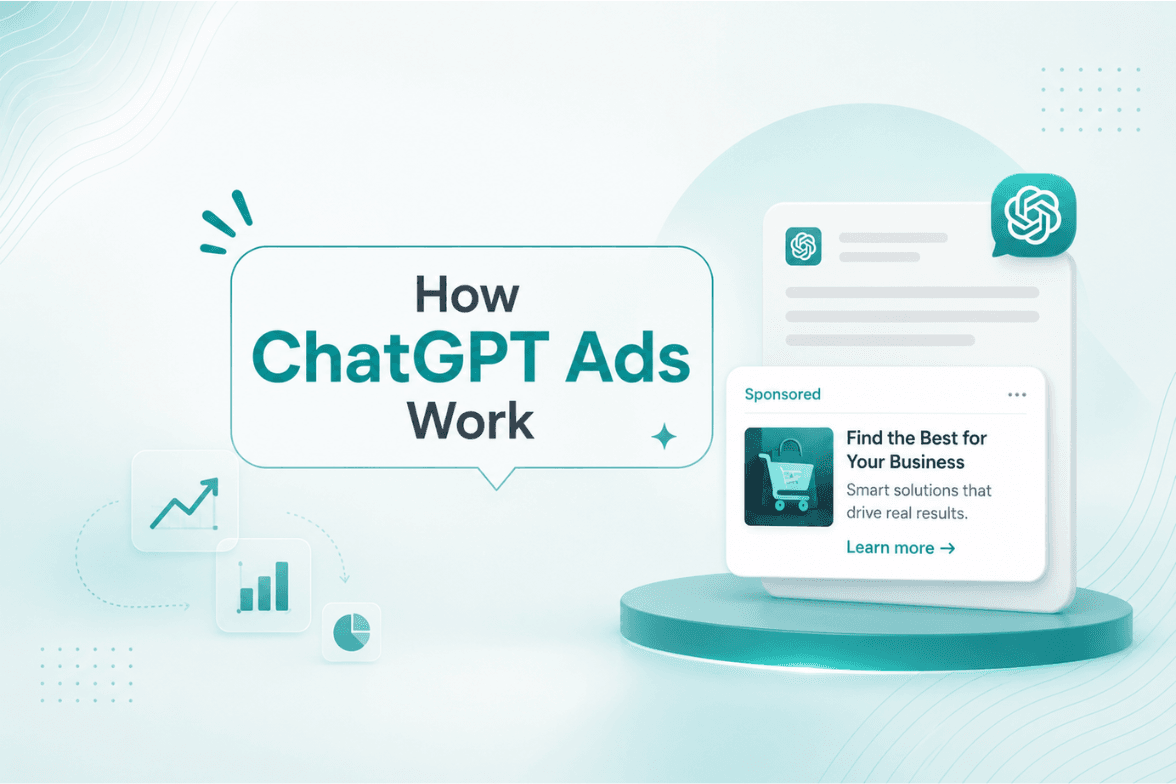
A ChatGPT ad is a sponsored card that appears at the bottom of a ChatGPT response. It carries a short headline, a description, an image, and a link to your site, and it sits in a visually separated box marked “Sponsored.” It looks and behaves more like a native placement than a banner.
OpenAI has been firm on a few principles that shape the product. Ads do not influence, rank, or alter the answer ChatGPT gives. Advertisers never receive access to the private content of a user’s conversation. Ads are withheld from sensitive contexts such as politics, health, and mental health, and are not shown to accounts identified as belonging to people under 18. Users can control how their ad experience is personalized and can clear their advertising data.
There are two ad formats. Static ads use a headline, description, and image that you supply. Product ads pull from a product feed and, since late July 2026, can display prices and star ratings, which makes them a natural fit for e-commerce.
Who sees ChatGPT Ads (and who never will)
This is the single most important thing to understand before you budget a rupee or a dollar. Ads only serve to users on the free and Go tiers, including logged-out sessions, and only to those OpenAI believes are 18 or older. Subscribers on Plus, Pro, Team, Business, and Enterprise plans do not see ads at all.
That limitation has a direct effect on who you can reach. If your ideal customer is a senior engineer or an enterprise buyer who almost certainly pays for ChatGPT Pro, this channel will struggle to find them. If your audience skews toward consumers, small business owners, students, and price-conscious users who rely on the free tier, the reach is far better aligned.
The practical read: ChatGPT Ads currently favors business-to-consumer and small-business advertising over high-end business-to-business targeting. That will shift as the platform matures, but plan around it today.
Where ChatGPT Ads are available in 2026
Availability has expanded fast, and this is where most existing guides are out of date. ChatGPT Ads started in the US, then added Canada, Australia, and New Zealand, followed by the United Kingdom, Japan, and South Korea, with Brazil and Mexico following in August 2026. From September 1, 2026, advertisers can buy directly through Ads Manager across India, Europe, the Middle East, and North Africa. OpenAI states the platform is now available in more than 40 countries.
For businesses in India, the UK, Canada, Australia, and the UAE, that means the channel moved from “watch this space” to “you can run a campaign today” within a matter of weeks. Because OpenAI adds markets on a rolling basis, confirm your specific country inside Ads Manager before you plan spend, since the country list changes often.
How ChatGPT Ads actually work
Here is the mental shift for anyone coming from Google Ads management or Meta. There are no keywords. No demographic filters. No in-market audiences.
Instead, ChatGPT matches ads to the meaning of the current conversation, and, for users who allow personalization, to broader signals from their ChatGPT activity. None of that underlying signal is shared with you. You cannot see the prompt that triggered your ad or the themes ChatGPT associated with it.
The main lever you control is a freeform field called context hints, set at the ad group level. OpenAI describes it as a place to describe the conversations, topics, or keywords where your product may be relevant, and treats these as guidance rather than exact-match rules. You can leave it blank, paste a keyword list, or write a full plain-language description of your ideal customer and their situation.
Early testing suggests the format of that field matters. In one published experiment by agency StubGroup, an ad group built from a plain keyword list actually served more often, with a slightly higher click-through rate and lower average cost per click, than an ad group built from full conversational questions. That is a single test on one account, so treat it as a prompt to run your own comparison rather than a rule. The field is new enough that structured testing is the only reliable way to learn what your audience responds to.
Winning ads are selected through what OpenAI describes as a relevance-weighted, second-price auction, similar in spirit to Google’s Ad Rank. Your bid, your ad quality, and your landing page relevance all feed into whether you appear.
How much do ChatGPT Ads cost?
Entry is deliberately cheap, which is part of why testing makes sense. You can run campaigns with a daily budget as low as $25, a long way from the $200,000 minimum commitments OpenAI required during the original pilot.
Reported click costs sit in the $2 to $5 range across industries in early campaigns. Practitioners have noted that setting a maximum cost per click below roughly $3 can trigger a warning that your ad may not deliver, which points to a soft price floor at this stage of the platform’s life.
Bidding follows three familiar objectives. You can bid for Clicks and pay per click with a maximum bid, bid for Reach and pay per thousand impressions, or bid for Conversions if you have OpenAI’s pixel installed. OpenAI has since added automated and outcome-optimized bidding, which now accounts for the majority of campaigns on the platform.
How to set up your first ChatGPT Ads campaign
The workflow will feel familiar to anyone who has run Google or Meta campaigns. Here is the sequence.
- Confirm eligibility. OpenAI restricts several categories, including adult content, alcohol, tobacco, financial services, and gambling. Some policy wording is still inconsistent, so check OpenAI’s current ad policies against your specific offer before you build.
- Gather your account details. You will need a legal business name, a business tax ID such as an EIN or its local equivalent, a payment method, and a favicon. Create your account at ads.openai.com. OpenAI asks agencies not to create accounts on behalf of clients; instead, the client creates the account and adds the agency as a user. There is no equivalent to a Google Ads manager account or a Meta Business Manager yet.
- Build the campaign structure. ChatGPT Ads uses the standard Campaign, then Ad group, then Ad hierarchy. At the campaign level you set the type, objective, locations to target or exclude, budget, and dates. At the ad group level you set your bid, a default destination URL, and your context hints. At the ad level you write the creative.
- Meet the ad specs. Headlines run to a 50-character maximum and descriptions to 100 characters, and both can be truncated, so front-load the important words. Images should be square, at least 256 by 256 pixels, in PNG or JPG.
- Set up measurement before you launch. Install OpenAI’s pixel to track conversions and, for e-commerce, dynamic values such as order revenue. Add UTM parameters to every ad URL so you can see ChatGPT Ads traffic cleanly in GA4 and other systems. This step is not optional if you want to judge the channel honestly.
- Launch small and watch. Reporting covers impressions, clicks, spend, click-through rate, average cost per click, and average cost per impression. Performance can currently be segmented only by country, even if you target a narrower region, so structure campaigns accordingly if geographic breakdowns matter to you.
ChatGPT Ads vs Google Ads vs Meta Ads
The closest comparison is Google Search, not social media, because you are reaching people who are actively researching and deciding. This table lays out the practical differences.
| Factor | ChatGPT Ads | Google Ads (Search) | Meta Ads |
|---|---|---|---|
| Intent | High, mid-research | High, active search | Low to mid, interruption |
| Targeting | Conversation context, context hints | Keywords, audiences | Interests, behaviors, lookalikes |
| Keywords | None | Core lever | Not applicable |
| Ad format | Sponsored card below the answer | Text and shopping results | Feed, Stories, Reels |
| Audience | Free and Go tier users, 18+ | All searchers | Platform users |
| Measurement | Pixel, Conversions API, limited reporting | Mature, granular | Mature, granular |
| Maturity | Weeks old, evolving fast | Two decades | Over a decade |
| Entry cost | $25 per day, no big minimum | Flexible | Flexible |
The takeaway is not that ChatGPT Ads replaces anything. It reaches people at a research moment that paid search and organic do not fully capture, but with far less control and far less data. It is an addition to the media plan, not a substitute.
Do ChatGPT Ads convert? What the early data shows
This is where honesty matters more than hype, because the public numbers point in two directions.
On the optimistic side, OpenAI has published several advertiser results. An e-commerce advertiser, widely reported to be Newegg, achieved a 3x return on ad spend across campaigns over a 28-day period, and reported 7x during a two-week promotional sale. A technology partner reported that more than 80% of its ad-driven ChatGPT traffic came from new customers, a strong signal for acquisition rather than just re-reaching existing buyers. VistaPrint reported that most of the traffic ChatGPT drove was new visitors, and Best Buy’s VP of Media, Amy Adams, said its click-through rates were higher than anticipated. Early advertisers named by OpenAI include Lowe’s, Best Buy, Newegg, and VistaPrint, which cluster around research-heavy and comparison-driven purchases.
Here is the balance those numbers need. OpenAI presented these figures at its own sales webinar with no methodology attached, and they represent wins rather than averages. Independent signals are more mixed. In a GA4 comparison of roughly 1,500 users published by StubGroup, traffic from Google Ads was far more engaged than traffic from ChatGPT Ads, with an average engagement time of 41 seconds versus 17 seconds and a conversion rate of 3.71% versus 0.21%. Several agencies have said publicly that they did not see meaningful performance from their ChatGPT campaigns. eMarketer’s August assessment was that the ad infrastructure remains basic next to Google and Meta, with underdeveloped performance insights, and it advised advertisers to press OpenAI for real return-on-ad-spend proof.
The reasonable conclusion sits between the two. ChatGPT Ads can reach people who were never going to see your Google or Meta ad, and for the right offer that incremental reach is valuable. But you should judge the channel on your own cost to acquire a customer, measured with your own pixel and UTMs, not on OpenAI’s showcase figures.
Is ChatGPT Ads right for your business?
A short decision framework, based on what the channel does well today.
Good-fit signals
- You sell to consumers or small businesses, where free and Go tier users are common.
- Your product involves research or comparison before purchase, such as retail, home goods, electronics, education, or travel.
- You already see organic traffic or brand mentions coming from ChatGPT, which suggests your category shows up in these conversations.
- You can commit a small, patient testing budget and measure it properly.
Wait signals
- Your buyers are senior or enterprise decision-makers who almost certainly pay for ChatGPT.
- You need granular reporting and audience control to justify spend internally.
- You have no measurement in place and cannot track conversions cleanly.
- Your category falls into a restricted or ambiguous policy area.
Most businesses fall somewhere in the middle, which is exactly why a controlled test beats both ignoring the channel and betting big on it.
Where ChatGPT Ads fit alongside your AI visibility strategy
Paid placement is only half the picture. The more durable play is showing up in ChatGPT’s answers organically, so that your brand is part of the conversation whether or not you are paying that day. OpenAI has been clear that running ads does not affect whether your brand is mentioned organically, and vice versa, which means the two work as separate but complementary tracks.
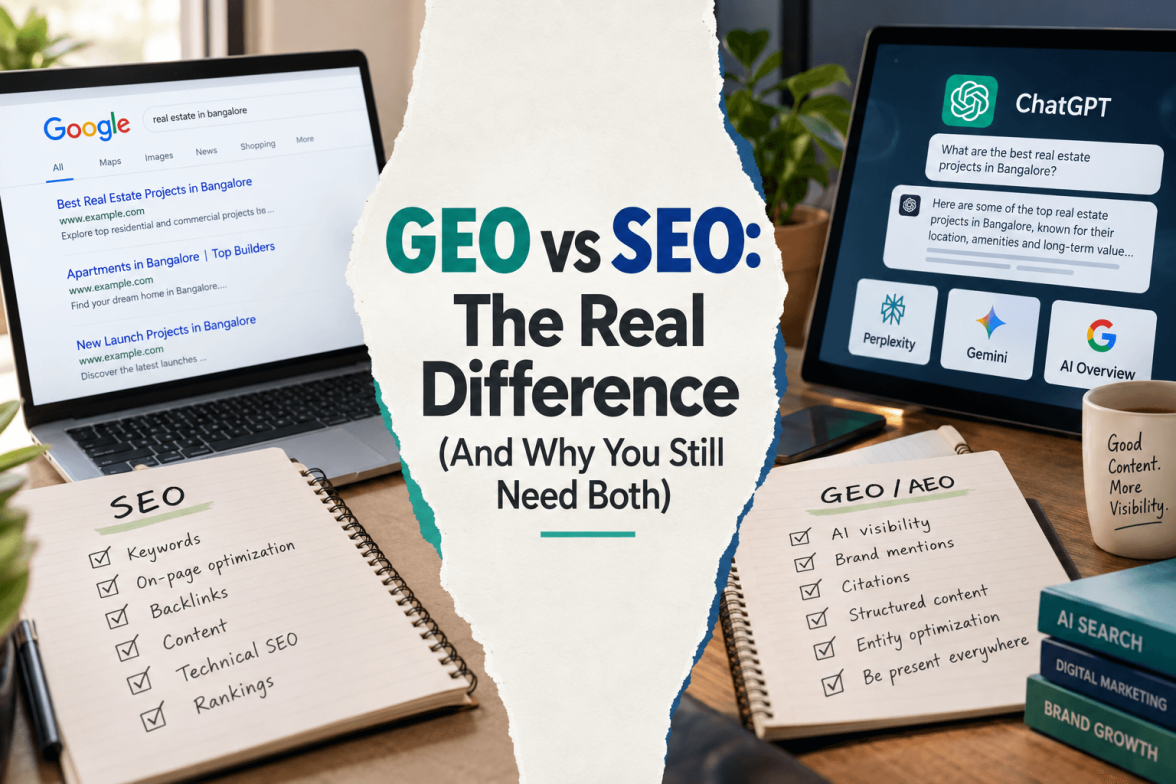
Treat ChatGPT Ads as the fast, controllable lever and organic AI visibility (GEO/AIO) as the compounding one. A business that earns citations in AI answers and also tests paid placement covers both the near term and the long term of AI-driven discovery. If you are investing in one, it is worth building the other in parallel, because the same audience is making decisions across both surfaces.
Getting started without wasting budget
A sensible first test looks like this. Start with a small daily budget, one clear objective, and conversion tracking installed before you launch. Build two or three ad groups with different context hints so you can learn what the matching engine rewards for your product. Add UTMs to everything. Run it for at least two to four weeks, because early data is noisy. Then compare your real cost per acquisition against your other channels, and scale only what earns its place.
ChatGPT Ads is early, imperfect, and moving quickly. That is precisely why the businesses that learn the platform now, carefully and with clean measurement, will understand it better than competitors who wait for it to settle.
If you want help deciding whether ChatGPT Ads fits your business, setting up measurement correctly, or running paid and organic AI visibility together, request a quote from Touchstone Infotech and we will build a plan around your market and budget.
Frequently asked questions
How do ChatGPT ads work?
ChatGPT matches sponsored cards to the topic of the live conversation, then shows the winning ad below the answer for free and Go tier users. Advertisers guide matching through a freeform context hints field rather than keywords, and ads are chosen through a relevance-weighted, second-price auction.
How much do ChatGPT ads cost?
You can start with a daily budget as low as $25. Early campaigns show average costs per click of roughly $2 to $5, and setting a maximum below about $3 can trigger a delivery warning.
Can small businesses advertise on ChatGPT?
Yes. Since the self-serve Ads Manager opened, there is no large minimum spend, which puts the channel within reach of small and medium businesses for the first time.
Who sees ads on ChatGPT?
Only users on the free and Go tiers who are 18 or older, including logged-out sessions. Plus, Pro, Team, Business, and Enterprise subscribers do not see ads.
Is ChatGPT Ads available in India, the UK, or the UAE?
Yes. Self-serve buying reached India, Europe, the Middle East, and North Africa from September 1, 2026, adding to markets such as the US, UK, Canada, and Australia. OpenAI reports availability in more than 40 countries, so confirm your exact market inside Ads Manager.
How is ChatGPT Ads different from Google Ads?
Google Ads targets keywords and audiences with mature reporting. ChatGPT Ads has no keywords, targets conversation context, reaches only non-paying users, and offers limited reporting. It is closer to Google Search in intent but far younger as a product.
Do ChatGPT ads actually convert?
OpenAI has published wins such as a 3x return on ad spend for one e-commerce advertiser, but those are self-reported and represent best cases. Independent tests show lower engagement and conversion than Google Ads. Judge the channel on your own measured cost per acquisition.