
If you have already read our breakdown of AIO vs AEO vs GEO, you have the wide-angle view. This is the narrower question people actually type into Google: how does GEO stack up against SEO, the thing most Indian businesses already pay someone to do?
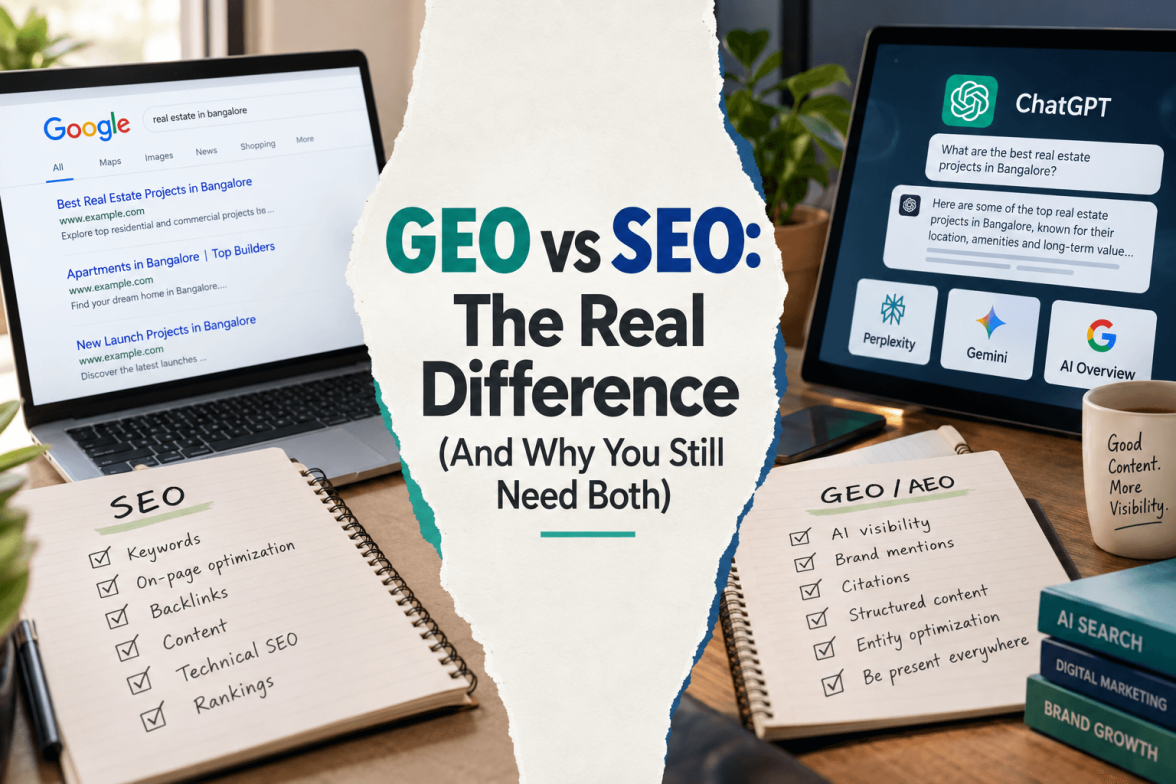
Short answer: SEO gets your content ranked. GEO gets your content quoted. SEO measures success in rankings and organic traffic. GEO measures it in how often AI tools mention your brand, linked or not. They are not competing for the same job, and most businesses in India now need both running at once.
What this means for your business
AI tools do not hand back ten blue links anymore. They hand back one answer, built from several sources at once. If your goal is showing up on a results page, that is still SEO’s job. If your goal is being the source the AI quotes when it writes that answer, that is GEO’s job, and it is a newer, different game.
Picture a Pune homeowner asking ChatGPT for “the best interior designer near me for a 2BHK.” The AI names two or three firms. If your studio was not one of the sources it trusted, you were never in the running, even if you sit at the top of Google for that exact phrase.
Key takeaways
- SEO ranks pages. GEO gets pages cited inside AI-generated answers. Different goal, different scoreboard.
- You measure SEO with rankings and traffic. You measure GEO with citation frequency and share of voice across AI tools.
- GEO does not replace SEO. Most of what makes a page good for GEO, such as clear structure, real expertise, and accurate detail, also helps it rank.
- The fastest GEO win is restructuring content you already have, not writing more of it.
- If Google Analytics is the only thing you watch, you are blind to half of what is happening to your visibility.
What SEO actually optimises for
SEO is the practice of getting a page to rank on a search engine results page. The reader still types a query, scans a list of links, and clicks one. Your job is to be one of the first few they see.
The mechanics have not changed much: keyword relevance, useful content, fast pages, mobile-friendly design, and backlinks from sites Google trusts. You build topical authority over months, not days. You measure progress with rankings, impressions, and organic traffic in Google Search Console.
The reader does the comparing. A Mumbai shopper looking for a CA opens three tabs, reads each one, and decides for themselves. SEO gets you into that comparison. It does not win the comparison for you.
What GEO actually optimises for
GEO, or generative engine optimisation, is the practice of structuring content so AI tools like ChatGPT, Perplexity, and Google’s AI Overviews can pull it into the answer they generate, instead of sending the reader off to compare links.
Here is the difference in practice. Search “best CRM for a five-person sales team” on Google and you get ten links to compare yourself. Ask the same thing in ChatGPT or Perplexity and you get one answer naming two or three tools, built from whichever pages the AI trusted enough to quote. If your page was not one of those sources, you were not in the running, even at Google rank one.
This matters more every quarter. A 2025 Semrush study of over ten million keywords found that the share of Google queries showing an AI Overview roughly doubled in three months, moving from about 6% in January 2025 to around 13% by March. Separately, research from Bain suggests most consumers now lean on AI answers for a large slice of their searches, and that this is already pulling organic traffic down by a meaningful margin. The trend is one-directional.
Why GEO and SEO work so differently under the hood
The gap between the two comes down to how the machine handles your content.
A search engine crawls the web, stores pages in an index, and ranks them against your query using signals like keywords, backlinks, and site speed. Ask the same question twice and you usually get the same ranked list. It is predictable.
A generative engine does something else. When someone asks a question, the AI does not hunt for that exact sentence. It breaks the question into smaller pieces, retrieves passages that answer each piece, and writes one fresh response from what it finds. Researchers call this query fan-out. Your content is not ranked so much as selected, summarised, and sometimes rewritten.
That has a blunt consequence for anyone trained on old-school SEO. A 2023 Princeton and IIT Delhi research paper, which first coined the term GEO, tested this directly. Keyword stuffing, one of the oldest tricks in the book, actually hurt performance inside generative engines. Adding real citations, direct quotes, and concrete statistics lifted visibility in AI answers by up to 40% in their tests. The AI rewards substance, not repetition.
GEO vs SEO, side by side
| SEO | GEO | |
|---|---|---|
| Goal | Rank on the results page | Get cited inside the generated answer |
| What the reader sees | A list of links to compare | One synthesised answer, sometimes with sources |
| What you control | Your own site: content, structure, technical health | Your reputation across the wider web, not just your domain |
| Core lever | Keywords, backlinks, technical SEO | Clear structure, citations, statistics, brand mentions elsewhere |
| Success metric | Rankings, impressions, organic traffic | Citation frequency, share of voice, brand mentions |
| Where you measure it | Google Search Console | Manual prompt testing or a dedicated AI visibility tool |
Where does AEO fit in?
You will see a third term thrown around: AEO, or answer engine optimisation. It is easy to muddle, so here is the clean line.
AEO targets the single best answer that a system pulls and displays, such as a Google featured snippet, a “People also ask” box, or a voice reply from Google Assistant. Your content is copied out as the answer, usually with your link attached. It is close to classic SEO.
GEO targets something looser. The AI combines several sources into one written response and may mention your brand with a link, mention it with no link, or use your information with no visible credit at all. In AEO your content is the answer. In GEO your content is part of the answer.
For most Indian businesses the practical point is this: the same well-structured page can win all three at once. A blog that answers a real question clearly can rank in Google, get lifted into a snippet, and get quoted by ChatGPT. You do not need three separate content teams. You need one page built properly. Our full guide to AIO, AEO and GEO goes deeper on the distinctions.
Does GEO replace SEO?
No, and anyone telling you to drop SEO for GEO is selling something. There is a real overlap: pages that already rank well organically tend to show up more often as AI citations, especially in Perplexity and Google’s AI Overviews. Good SEO gets your content crawled, indexed, and trusted enough to be in the running. GEO decides what happens once the AI actually has it in front of it.
Think of SEO as getting into the room. GEO is what you say once you are standing in it.
How to measure each
This is where most teams quietly lose the thread. They keep watching the same dashboard and wonder why visibility feels different from what the numbers say.
SEO measurement is familiar territory: rankings, organic traffic, click-through rate, and backlinks, all visible in Search Console and a rank tracker.
GEO measurement is newer, and you can start it by hand today. Pick the ten questions your customers would actually ask an AI tool, for example “which digital marketing agency in Dwarka is good for a small business.” Ask each one in ChatGPT, Perplexity, and Google’s AI Overview. Note three things every time:
- Are you mentioned at all? This is your citation frequency.
- Are you linked, or just named? A named mention still builds brand recall even with no click.
- Who shows up instead of you? This is your share of voice against competitors asked the same question.
Past a handful of prompts a week, manual checking stops scaling, and that is when a dedicated AI visibility tracker earns its place in your stack. But you do not need to buy anything to get your first honest baseline.
Common mistakes Indian businesses make with AI search
From what we see with clients, the same few errors come up again and again.
Treating AI like a keyword game. Stuffing “best digital marketing agency in Kanpur” fifteen times used to move rankings. Inside a generative engine it does nothing, and the research suggests it can actively hurt you. The AI wants a clear, factual answer, not repetition.
Burying the answer. If the direct answer to a question sits in paragraph nine, the AI is far less likely to lift it. Put the plain answer in the first two or three sentences under the heading, then expand.
Living only on your own website. AI tools weigh what the wider web says about you, not just your homepage. If your business is invisible on Justdial, IndiaMART, Google Business Profile, industry roundups, and relevant Reddit or Quora threads, the AI has little reason to trust you. A consistent presence across these builds the credibility the model looks for.
Watching only Google Analytics. A GEO win often shows up as a mention with zero clicks attached. You can do everything right and see no referral traffic, because the AI simply said your name instead of linking to you. If GA is your only mirror, you will miss it.
What to do this week
None of this needs a separate content team. Most GEO work is restructuring what you already have.
- Add a direct answer up top. Put a two to three sentence answer right under your H1 or first H2, before any preamble.
- Add a key takeaways block. A short bulleted summary near the top of longer posts. AI tools pull from these constantly.
- Replace vague claims with specifics. Swap “we get great results” for named numbers, dates, and sources the AI can quote.
- Fix your FAQ headings. Use the actual question word for word, the way a customer would ask it, not a rephrased version.
- Check your off-site footprint. Search your brand on the third-party sites the AI already trusts, such as Justdial, IndiaMART, and industry roundups, and fill the gaps.
You are not abandoning your SEO work to do any of this. You are editing for a reader that skims fast and quotes selectively, whether that reader is a person or a model.
Already doing SEO? Good, that is half the work. GEO is the next layer on top of what you are already running, not a separate budget line. If you want to know where your brand actually stands in ChatGPT, Perplexity, and AI Overviews before you spend anything, a structured audit is the sensible first step. Touchstone’s SEO and AI visibility audit maps exactly where you are getting cited, where you are getting skipped, and which existing pages to restructure first.
FAQs
Is GEO the same as SEO?
No. SEO optimises a page to rank in search results. GEO optimises a page to get cited inside an AI-generated answer, which often happens with no ranking and no click at all.
Does GEO replace SEO?
No. AI tools still pull a large share of their citations from pages that already rank well organically, so weak SEO usually means weak GEO too. You need both.
How is GEO different from AEO?
AEO targets featured snippets, voice answers, and “position zero” inside traditional search, where your content is displayed as the single answer. GEO targets citations inside fully generative answers from tools like ChatGPT and Perplexity. AEO sits closer to classic SEO. GEO is its own discipline.
Do I need to do GEO if I already do SEO?
If your customers are asking ChatGPT, Perplexity, or AI Overviews the kinds of questions your business answers, yes. If your audience still searches and clicks the old-fashioned way, SEO alone may hold for now, though that is changing fast in India.
How do you measure GEO success?
Track how often your brand shows up across a set of real prompts in tools like ChatGPT and Perplexity, whether the mention is linked or just named, and how that compares with competitors asked the same questions.
Can a small Indian business compete in GEO?
Yes, often more easily than in traditional SEO. AI tools tend to reward clarity, structure, and consistent off-site presence over raw domain size, so a small, well-organised site with a solid Justdial and Google Business Profile footprint has a real chance of being cited.
How long does GEO take to show results?
It varies. Because AI systems favour fresh, well-structured content, a restructured page can start getting quoted faster than it would climb Google rankings. Consistency matters more than speed, since visibility builds as more trusted sources mention you.
Do backlinks still matter for GEO?
Yes, but their role shifts. Backlinks and brand mentions now act as trust signals that help an AI decide whether your content is credible enough to quote, a point echoed in Google’s own guidance on optimising for AI search.